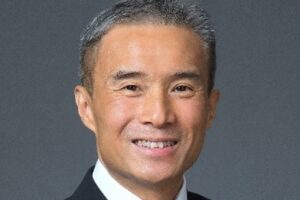
Drawing on an extensive management background in telecom, IT, and digital, Vincent Ma now serves as CEO of the Hong Kong-Shenzhen Innovation and Technology Park (HSITP). He outlines the under-construction tech park’s unique positioning, linking Hong Kong’s jurisdiction with mainland China’s resources, and HSITP’s plans to attract both Chinese and overseas companies looking to use Hong Kong as a steppingstone.
Can you share your background and what attracted you to this complex opportunity which is closely related to innovation and science in particular?
My background is in computer science, having started out as a systems engineer with IBM, where I worked for seven years. Then in 1995, I transitioned to the telecom industry, which was undergoing deregulation worldwide. I joined a new telecom company in Hong Kong called Wharf T&T of the Wharf conglomerate. They had just obtained a license and were looking to build a new telecom company, so I joined and helped build it from the ground up.
I spent 23 years at Wharf T&T, starting as a sales manager and eventually becoming the president, then the CEO in 2006. I led the company until we sold the telecom assets to private equity firms TPG and MBK Partners at a record high multiple, followed by an M&A two years later. After that, I decided it was time for a change and left the telecom industry. I then joined Sun Hung Kei Properties, another major conglomerate in Hong Kong, to help build their digital office. My experience spans telecom, IT, and digital, predominantly in general management roles where I have overseen business operations and P&L.
My transition to the sciences industry was really a coincidence. About 18 months ago, the Hong Kong-Shenzhen Innovation and Technology Park (HSITP) was looking for a new CEO, and they launched an executive search. An agent contacted me about the opportunity – although I did not know much about the company or the project initially, I was intrigued once I learned more.
The HSITP project was quite low-profile at the time, but I found the concept fascinating once I understood it. The Park needed someone with a strong background in general management to build up the organization. This role involves creating a whole new infrastructure – from space to ecosystems to talent – essentially developing a prototype for a small innovation and technology (I&T) city. It is a very exciting challenge.
Could you provide an overview of the HSITP? How does it compare to similar innovation and science parks in mainland China, and what are its primary objectives?
Like many other tech parks, we have a piece of land where we are building from scratch. What sets us apart is that HSITP, along with our tenants, will operate under Hong Kong’s jurisdiction and the Basic Law, while enjoying an unprecedented level of access to the resources in mainland China. Moreover, we have the geographical advantage of being the closest to mainland China, with our park nestled along the Shenzhen River.
Our initiative stems from the Central Government strategy emanated from Beijing, aiming at building up China’s Information and Technology (I&T) capabilities. The Central Government has a clear vision in its 14th Five-Year Plan to develop the Greater Bay Area into a major I&T hub. This area, comprising 11 cities and contributing a significant portion of the country’s GDP, is seen as a vital bridge to achieving these goals.
Shenzhen and Hong Kong play crucial roles in this strategy, as they boast respective advantages in mainland China and the Special Administrative Region. The Central Government views
this as an opportunity to implement new and innovative policies to support its strategies, such as the cross-boundary free flow of data, personnel, capital, and biomaterials, all of which are unique enablers of HSITP to foster I&T development.
Together with the Shenzhen Park, we form the Hetao Shenzhen-Hong Kong Science and Technology Innovation Cooperation Zone (The Cooperation Zone). This collaboration serves as a testbed for new cross-boundary policies. Once successful, these policies have the potential to be expanded in other parts of mainland China.
Hong Kong has excelled in the finance and real estate industries, but with ongoing global development, the new strategy now is to leverage I&T for industrial growth. HSITP will offer the right opportunities for Hong Kong to develop into an international I&T powerhouse. Hong Kong’s scientific leaders are well recognized globally, but in the past, our city had limitations in mainstream commercialization, as well as translational research and industry development.
Our city is resolved to leverage our strengths and become a Global Innovation Hub, with Advanced Manufacturing as a core impetus. By leveraging the Greater Bay Area, which is 10 times the size of Hong Kong, our partners will enjoy the best of both worlds, with access to a larger market and more logistical capabilities. This new synergy will enable Hong Kong to develop its I&T industry with scale.
In a nutshell, the HSITP has strategic advantages under the Central Government’s support, complemented by cross-boundary policies, the comprehensive strengths of the Greater Bay Area, as well as the “One Country, Two Systems” principle in Hong Kong. This combination of attributes has HSITP uniquely positioned compared to other innovation and science parks.
In light of the current real estate crunch due to high interest rates, how is the project’s financing set up? The Hong Kong government´s budget is self–financed without central government support. Is that the case with the HSITP?
HSITP will be developed in six batches across two phases. Eight buildings in Phase One will be funded by the Hong Kong government. For the remaining buildings of Phase One and Phase Two development, the government intends to use alternative models such as the Public-Private Partnership (PPP) model.
In the public sector, the Hong Kong government has established the Hong Kong Investment Company (HKIC) with a total of HKD 60 billion in funding. HKIC aims to use this funding to stimulate public and private co-investments. Their approach is to leverage their resources as guidance to identify promising opportunities, encouraging private investors to follow suit.
Given the current high interest rates, the financial burden is challenging. However, we have found significant interest from both local and international partners. They see HSITP’s potential and are eager to identify good investment opportunities, either in assets or companies. Despite global economic uncertainties and high interest rates, many investors still have the resources and are seeking the right opportunities. The unique nature of HSITP presents such opportunities, attracting considerable attention from potential investors.
If you look at the 59 partnership enterprises that were announced at the HSITP Partnership Launching Ceremony in April this year, not all of them are park tenants – many of them are
potential partners who are interested in various forms of collaboration, including incubation, acceleration, investment and professional services, as well as universities and research institutes. Our partners are eager to become part of the HSITP ecosystem, because they want to understand and to closely monitor the unique opportunities here. This shows a high level of interest and optimism in both Hong Kong and mainland China.
How important is the biomedical sector for the HSITP and beyond the biomedical field, what other industries are you targeting to create an interdisciplinary hub and what role will talent play?
The biomedical sector falls under the Life & Health Technology industry, which is one of HSITP’s six pillar industries that are in line with the Hong Kong I&T Development Blueprint. Life & Health Technology is a major focus for us, with nearly half of the space in Phase One designated for wet
laboratory-enabled facilities. Our goal is to create an interdisciplinary hub that promotes synergy among the six pillar industries – in addition to Life & Health Technology, we will also focus on Artificial Intelligence (AI) and Data Science, New Energy, New Materials, Robotics, and Microelectronics. These industries will all feed into Advanced Manufacturing, for which we will also have designated zoning in HSITP.
To grow these industries, several elements are needed. Firstly, space is crucial. We have unique types of spaces that will be available, supported by the Central Government’s vision and strategic cross-boundary policies.
Talent is another critical element. We already have a strong talent base for basic research in Hong Kong, particularly in the biotech sector. The government is also working hard to attract foreign talent, offering financial subsidies to bring in experts from mainland China and overseas. At HSITP, we will provide accommodation and communal facilities to support professionals and their families, making it easier for them to settle here.
Moreover, with HSITP’s proximity to Shenzhen and other parts of Hong Kong, our partners can tap into the R&D talent pools of both cities. This is a great appeal to multinational companies that wish to establish a presence in Hong Kong and gain market access in mainland China.
Many biotech companies operate across China’s provinces, often needing a presence in major cities like Beijing and Shanghai for pure market reasons. What strategic advantages does the HSITP offer, and what types of companies do you envision establishing operations there?
We expect to engage with at least two types of companies. The first type is emerging companies taking their initial steps going global. The second type is those looking to expand their current operations but facing challenges in attracting talent to this part of the world. With the setup in Hong Kong, these companies find it much easier to bring in and retain talent. HSITP will serve as a “Super Connector”, which will play well into Hong Kong’s strengths. We’re aiming to attract overseas companies to use Hong Kong as a steppingstone into mainland China and vice versa – bringing companies from mainland China to Hong Kong and helping them expand globally.
We have been having discussions with many companies, and they recognize the value we offer. We have also spoken with other I&T parks in mainland China and we plan to collaborate with them. These large parks have many tech companies that may be struggling with expansion outside of mainland China; by partnering with us, these companies can expand beyond the boundaries, using Hong Kong as a gateway.
Hong Kong excels in a few key areas. First, we have attractive listing regimes on the Hong Kong Stock Exchange – namely Chapters 18A and 18C, which enable efficient listings of biotech and
specialist technology companies. Second is our IP protection system, which is crucial for small, pre-revenue tech companies. Another advantage is access to top-notch talent and basic research capabilities in Hong Kong. Overseas talent coming to Hong Kong can integrate with local experts, creating synergies that enhance R&D development.
Furthermore, HSITP presents an excellent opportunity for talent development. We are well positioned to attract and nurture talent on an international level. Mainland Chinese companies can send their talent to Hong Kong to develop new experiences and skills, creating a robust workforce ready to drive innovation and expansion.
What is the expected timeline for the Park’s development, and when do you anticipate welcoming the first tenants?
Our next key milestone is soon approaching, with the completion of our first building by the end of this year (2024). By the second quarter of next year, we will have three buildings available. We expect the first tenants to start their renovations in Q2 next year. Taking into consideration the lead time for lab facility construction, which may take a few more months, we anticipate our R&D tenants to begin operations in the second half of next year.
We plan to launch our incubation programmes by the end of this year or early next year. Our approach to incubation will be a collaborative one, working hand-in-hand with our partner incubators to support start-ups in our six pillar industries. We also plan to offer incubation programmes to nurture biotech companies at the early stage of their development.
There has been some scepticism regarding Hong Kong’s integration with the Greater Bay Area, with concerns about it potentially losing its unique identity and socio- economic attributes. How would you address these concerns and reassure the community about the sustainability of the “One Country, Two Systems” principle?
The Hetao Shenzhen-Hong Kong Science and Technology Innovation Cooperation Zone is a prime example of how the “One Country, Two Systems” principle can create synergies rather than
diminish Hong Kong’s unique identity. The Central Government’s strategy is to leverage Hong Kong’s unique proposition and strengths – our financial system, IP protection protocol, and legal framework, to attract industries and foster industry development. This Cooperation Zone will showcase how cross-boundary policies can help companies expand, attract talent, and stimulate industry growth.
Hong Kong has always had unique advantages that are instrumental to I&T development, but in the past, we could not capitalize on these advantages due to lack of scale. The new cross-boundary policies in the Cooperation Zone will promote synergies between Hong Kong and Shenzhen, allowing smoother integration while maintaining our city’s distinct attributes.
If these policies prove successful, they may be expanded further into other parts of China, potentially broadening the market to 1.4 billion people. This strategic approach highlights the Central Government’s intention to use the “One Country, Two Systems” model intelligently and effectively, and HSITP will be a showcase of such strategies.