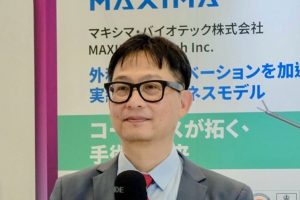
Dr Tom Tang, CEO of Maxima, discusses the company's strategic positioning in the surgical energy device market, Taiwan's emerging role in global medical technology manufacturing, and his vision for creating a replicable business model that could catalyse the nation's medtech industry. With a USD 19.5 billion market opportunity and plans for international expansion, Maxima represents Taiwan's ambitions in high-value medical device innovation.
Could you provide our international readers with an overview of your background and your journey to Maxima?
I have always positioned myself as a lifelong learner who actively seeks mentors – individuals who can illuminate areas beyond my existing expertise. This philosophy has led me to explore diverse career paths, each designed to test both my capabilities and limitations. My background is in mechanical engineering, and it was during my work at National Cheng Kung University in southern Taiwan that I first recognised how my technical skills could genuinely improve patient outcomes.
We developed a robotic system to assist surgeons in guiding needle insertions into the liver. At the time, in 1998, surgeons faced significant challenges with radiation exposure and patient movement during procedures. They had to alternate between viewing the images in a radiation-shielded room and performing the actual insertion, all while managing the patient’s breathing and organ movement. Our solution provided real-time guidance during the procedure itself. This coincided with the emergence of the Da Vinci surgical system, and it marked my first realisation that engineering could make a meaningful difference in healthcare.
Subsequently, I had the opportunity to pursue doctoral research at Leuven University in Belgium, where one of my advisors – Prof. Philippe KONINCKX, an exceptionally skilled gynaecologist – challenged me to develop a robotic laser system for endometriosis treatment. He recognised that whilst laser technology offered superior precision, it required exceptional manual dexterity that might not be sustainable throughout a surgeon’s career. My thesis focused on integrating an intuitive writing interface into a robotic platform for laser surgery.
The response from the bench trials with medical students and surgeons was remarkable. However, as an engineer, I lacked the knowledge to navigate the regulatory pathway from prototype to certified medical device.
What led you from academic research to your current role?
That experience at Leuven, coupled with subsequent training at Stanford Biodesign programme, fundamentally shaped my approach. Silicon Valley opened my perspective – it demonstrated that whilst anything is possible, execution quality determines success. The critical insight I gained was that ideas require rigorous validation, and validation demands assembling the best available expertise rather than attempting to master everything independently.
This represents a particular challenge within Taiwanese culture, where there is often reluctance to engage professional consultants or specialists due to perceived value concerns. However, successful medical technology development requires exceptional collaboration and project management – someone who can orchestrate diverse expertise and multiply the combined value of all contributors. I aspired to become that integrator.
This philosophy led to the establishment of Summed Taiwan, an angel fund launched in 2019, which provides not merely capital but access to approximately 200 domain experts. For start-ups, the scarcest resources are funding, knowledge, and practical know-how. We aimed to compress their learning curves and minimise costly trial-and-error cycles.
However, I recognised a fundamental gap in my own experience. Mr Yi-Ping Hong, who became my mentor, articulated it perfectly: one can read extensively and develop logical frameworks, but management is fundamentally about daily operations and making decisions with insufficient information. How could I effectively guide start-ups without direct operational experience?
Maxima presented the ideal opportunity. The company’s focus on technology aligned precisely with my background, and I quickly recognised we were approaching a significant market opportunity and a true “unmet medical need” based on Stanford Biodesign.
What are the structural challenges preventing Taiwan from developing globally recognised medtech companies?
This question has occupied my thinking considerably. The Taiwanese government has maintained medical technology development policies since 2003, yet we lack prominent names in the global medtech landscape – unlike Korea or Israel. When one examines the industry, companies from those nations feature prominently, but Taiwan remains largely absent from that conversation.
The fundamental issue is not missing components but rather integration and demonstrated success models. During my government work, I proposed to policymakers the idea that Taiwan possesses every necessary element, but we need to establish a working model that others can replicate. Taiwanese business culture excels at iteration and scaling once a proven template exists.
Maxima represents my attempt to create that template – to demonstrate the complete journey: the extended timelines required, the processes that must be followed, and the ultimate market success. Encouragingly, the market opportunity remains constant. The drive towards improved health outcomes and longevity continuously advances technology, ensuring demand persists.
Even global technology giants – Google, Amazon, Facebook – have attempted biomedical investments to expand their market scope. Yet today, the conversation has largely shifted to artificial intelligence, with limited tangible healthcare outcomes. This mirrors Taiwan’s experience: sustained investment since 2003, but current discussions dominated by AI trends rather than healthcare breakthroughs.
The persistent challenge is aligning technological capability with genuine healthcare needs. Needs must be identified from within the clinical environment. The approach of developing an AI system and subsequently searching for applicable problems has proven unsuccessful countless times.
Beyond policy and culture, healthcare faces a dual threat: rising costs and unstable supply chains due to geopolitical friction. Maxima addresses this by building what we call a “MedTech Foundry” – a system that separates innovation from realisation, akin to a semiconductor foundry. This approach prioritises resilience (“Just-in-Case”) over pure efficiency (“Just-in-Time”), ensuring continuity despite global uncertainties.
Taiwan is well positioned to apply this model effectively, combining rigorous innovation frameworks with significantly lower operating costs – an advantage in an industry defined by long cycles, trial and error, and substantial sunk costs.
How do you position Maxima today? Is it primarily a product innovator, service provider, technology platform, or OEM manufacturer?
We aspire to be what I term a “Robust” company. By this, I mean we prioritise quality systems above all else. Our device has been in the Taiwanese market since 2022, accumulating approximately 6,000 surgical procedures. As long as nothing adverse occurs, no one questions the technology. However, adverse events are inevitable in any medical device lifecycle.
Quality at Maxima extends beyond ISO 13485 certification – it is embedded in every team member’s mind-set and processes. We do not position ourselves as merely a knowledge repository or technology specialists. When we require specific expertise, technology, assembly capabilities, or services, we identify and integrate the appropriate external resources into our system.
Currently, we manufacture in-house, but our ultimate objective is not Maxima operating in isolation. We envision Maxima as an integrator – leveraging every strength and capability within Taiwan to serve the medtech industry whilst maintaining rigorous quality standards.
That said, our identity is unambiguous. Maxima is fundamentally a product company. Our revenues today are product-driven and will remain so in five years’ time. We develop our own products, define all technical specifications, and retain full ownership of the product vision and roadmap.
How do you approach specification development?
Our specifications fall into two categories: surgical requirements and engineering requirements. Surgical specifications address clinical needs – for instance, our devices must seal or cut tissue and blood vessels effectively. We must then translate those clinical requirements into engineering parameters such as amplitude and frequency.
Critically, we integrate customer feedback into next-generation specifications. This creates what we term an in-situ innovation loop. Surgeons provide subjective feedback based on tactile experience and will identify numerous concerns. However, technology and materials have inherent limitations. We must identify the viable middle ground, as we cannot invest infinitely in any single product.
Building on our in-situ innovation approach, Maxima benefits from the density of the Central Taiwan’s supply chain: 90% of suppliers are within a 60-minute drive. This proximity allows us to integrate real-time clinical feedback directly into product development, enabling us to iterate hardware as rapidly as software. Coupled with our partnership with Qisda, this infrastructure delivers industrial-scale manufacturing at 30-50% lower costs than those of legacy competitors.
We collect all feedback but organise it into a technology roadmap, recognising that not every advancement is immediately feasible. Consider our cordless ultrasonic dissector. Cordless surgical energy devices entered the market nearly twenty years ago, and we are only the second company globally to develop this technology – Medtronic was first, and they have executed exceptionally well.
What prompted you to enter this specific market segment?
When I examined cordless ultrasonic dissectors, I recognised a trajectory similar to landline telephones evolving into mobile devices: wireless functionality provides intrinsic value that everyone desires. Current devices are constrained by weight, limiting adoption, but future iterations will overcome this. Establishing the infrastructure to support continuous improvement is essential, because developing an ultrasonic dissector from scratch requires five to ten years to achieve basic functionality—not technological superiority.
Our approach draws on the execution benchmark set by global leaders, learning from their processes while re-engineering for performance improvements. Cordless devices will inevitably replace corded alternatives, and validating this trajectory offers surgeons enhanced dexterity and flexibility in the operating theatre.
From an investor perspective, while Maxima remains in the investment phase, capital is critical. Without it, meaningful progress in this segment would be impossible. The market opportunity is significant: the ultrasonic dissector category alone represents USD 5 billion, underscoring the scale and potential impact of our focus.
What is your strategy for international expansion beyond Taiwan?
We are in the process of obtaining 510(k) clearance from the US Food and Drug Administration, expected this year. Rather than entering the US directly, we will leverage this approval to access Southeast Asian markets, where opportunities are substantial. Direct US entry would trigger immediate competitive responses from global leaders, so our focus is on less saturated regions while advancing innovation ahead of larger players.
We anticipate securing European MDR certification next year and, by 2029, plan to launch third-generation devices globally as key competitor patents expire. In the interim, we are exploring strategic collaborations, leveraging Taiwan’s efficient supply chains, manufacturing quality, and technological readiness to accelerate partners’ development cycles.
Pricing is a deliberate competitive advantage: our products are approximately seventy percent of comparable offerings, reflecting the balance of superior quality, rigorous standards, and strategic market positioning.
Does that shift Maxima towards a service provider model?
Service provision is part of our strategic vision, though Maxima currently focuses on products. I have presented the concept of a “factory in a box,” encouraging nations to develop resilient medtech manufacturing capabilities. Simultaneously, we aim to provide contract services to major global manufacturers of ultrasonic devices, while the broader surgical energy market – encompassing ultrasonic and bipolar technologies – represents a USD 19.5 billion opportunity, which is our area of specialisation.
Maxima operates across multiple surgical energy modalities: ultrasonic devices harness mechanical energy, whereas bipolar devices rely on electrical energy. Taiwan’s combination of manufacturing quality and cost efficiency is critical in this sector. While both platforms are functional, capacity limits our ability to fulfil contract manufacturing fully. To address this, we have established a strategic partnership to enable CDMO operations beginning in 2027, though current priorities remain regulatory approvals and advancing our bipolar platform. The CDMO strategy is primarily internal at this stage, to manage organisational focus and expectations.
Looking at the evolution of medical device engineering, will competitiveness increasingly be determined by electronics and software specialists rather than traditional engineers?
Traditional engineering disciplines will retain their importance. If we examine surgical evolution, we have largely identified the technological platforms that can meaningfully assist procedures. We have explored countless innovations, but human anatomy and physiology remain constant. If the fundamental biological structures do not change, novel technologies often prove non-useful.
For life-saving interventions and longevity enhancement, we have tested thousands of potential improvements. However, the inherent risks of surgery impose constraints. In time-critical situations where a surgeon must act immediately to prevent patient mortality, you cannot introduce complex control requirements. The device must be intuitive – the surgeon grasps the instrument and achieves the desired result. This is the essence of effective device design: one-step solutions.
You mentioned fundraising earlier. How receptive are Taiwanese capital markets to medical device investments?
Initially, we encountered considerable interest, particularly before the AI investment surge. However, artificial intelligence has now captured significant funding attention. Additionally, geopolitical considerations – particularly our proximity to China – have dampened investment activity, especially in medtech. We consider ourselves among the fortunate companies that continue to operate normally.
Examining the stock market, Mr Hong’s company listed at the end of last year but has not generated substantial market interest. Across innovative medtech companies broadly, investor enthusiasm remains limited because investors ultimately require returns. Pharmaceutical and medical device companies represent future value propositions with inherent binary risk. From my perspective, this does not align well with Taiwan’s stock market characteristics.
For investors willing to accept high-risk opportunities, Silicon Valley presents more attractive options.
Looking ahead, we plan to list on Taiwan’s emerging stock market next year, aiming to achieve break-even by 2029. This milestone effectively represents our IPO, allowing us to focus first on scaling revenue and optimising margins before entering broader capital markets.
How do you plan to achieve those margins, and what operational, strategic, or technological levers will be critical to reaching profitability?
In Taiwan, we currently maintain 60 percent margins through direct hospital sales. This is not entirely attributable to our operational excellence. Taiwan’s current market relies entirely on imported energy devices, which accumulates pricing premiums. We enjoy certain pricing advantages compared to imported alternatives.
International markets present different competitive dynamics. However, when comparing supply chains across Taiwan, China, and the United States, Taiwan occupies a unique position. Absent the US-China trade conflict, Taiwan would struggle to compete directly with China. However, as medtech increasingly becomes a national security consideration, companies are withdrawing from Chinese manufacturing.
Taiwan can fill this vacuum. We offer production capabilities with superior quality, cost-efficiency, and cost-benefit ratios. Our demonstration focuses on scalability – one does not require extensive facilities or large workforces. We can automate substantially using robotics. With approximately one thousand square metres of production space, we can meet the surgical energy device needs of an entire nation. This is what we aim to demonstrate to national leaders: if they desire medtech resilience in surgical energy devices, we can provide turnkey manufacturing solutions.
Looking three to five years ahead, how do you envision Maxima’s market position, product portfolio, and global footprint evolving?
We position Maxima as an innovator in surgical energy devices, working closely with major manufacturers to translate surgeon requirements into functional, reliable products. Even global leaders like Johnson & Johnson face challenges—for example, in 2021 they recalled 70,000 ultrasonic devices due to a button mechanism flaw. With lower sunk costs and a nimble engineering team, we can refine devices and resolve issues before launching internationally. This is why our first product debuted exclusively in Taiwan, where the country’s exceptional medical services provide real-world feedback that directly informs engineering improvements.
In the next five years, we aim to define the standards for surgical energy devices, not through brand dominance but by partnering with manufacturers to deliver high-quality, competitively priced solutions. Our Cordless Ultrasonic Dissector has already captured roughly 10% of Taiwan’s self-pay market, validating our approach. More broadly, our ambition is to move from “Made in Taiwan” to “Enabled by Taiwan”—leveraging Taiwan’s dense, high-quality supply chain and local expertise to provide supply chain resilience while serving as a MedTech minimum viable product (MVP). This model allows rapid development, iteration, and validation of innovations, and our goal is to export this “Factory-in-a-Box” capability to global partners, helping them build healthcare autonomy and reinforcing Taiwan’s role as a hub for high-value medtech innovation.