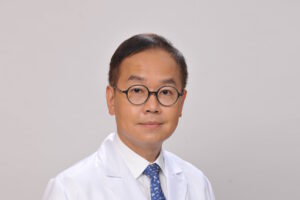
Professor Justin Che-Yuen WU outlines how strategic collaborations in the Greater Bay Area are expanding CUHK's influence in medical innovation, healthcare services, and clinical research. Professor Wu explains how these collaborations are crucial for integrating Hong Kong’s advanced medical practices into mainland China while leveraging the region's resources for innovation and healthcare development. He also highlights the urgent need for innovation and adaptation to better meet the healthcare needs of Hong Kong's aging population, and why Hong Kong's influence can drive positive change in mainland China rather than being diminished by the integration.
Could you share your academic background? Have you always been affiliated with the Chinese University of Hong Kong?
I have been working at the Chinese University of Hong Kong (CUHK) for more than 30 years, including at the public teaching hospital as a medical resident. I graduated about 30 years ago and trained as an internal medical specialist and gastroenterologist. I joined CUHK as academic staff in 2006, so I have been in academia for almost 18 years.
My primary focus has been on functional digestive disorders. This area has allowed me to work with various disciplines, including Chinese medicine and alternative medicines. Throughout my academic career, I have engaged with a wide variety of stakeholders, which has led to opportunities in medical innovation and technology. I have advisory and investor roles in some startup companies and medical venture capital funds. Additionally, I spent three years at CUHK Medical Center, which gave me experience in the healthcare business and private healthcare, allowing me to connect with commercial entities and insurers.
After three years as Chief Operating Officer at CUHK Medical Center, I returned to the medical school as Associate Dean of Health Systems. Under the leadership of Professor Philip Chiu, I help implement strategies to expand CUHK’s role in innovation and technology. We aim to enhance our portfolio in medical applied research, commercialization, and industry connections. This includes working with private healthcare providers, investors, and medical innovators. Hong Kong’s market is limited, so the Greater Bay Area (GBA) is a strategic location for us. We have been carefully planning collaborations and partnerships in the GBA, with two main projects in Nansha, Guangzhou and Qianhai, Shenzhen. Nansha, for example, has a special position as a state new district with responsibilities for integration and collaboration with Hong Kong and Macau. We expect to see many Hong Kongers working, living, and retiring there due to affordable land costs and convenient transportation.
What are the key areas of strategic collaborations in these two Greater Bay Area cities?
We have two distinct strategies for Shenzhen and Nansha. In Nansha, we signed a comprehensive MOU with the local government last year to build a holistic health system. We act as advisors and connectors to help build an ecosystem similar to Hong Kong’s. For instance, we are supervising the setup of health centres in a Tier 3A hospital in Nansha, which has a whole building ready for collaboration on theme-based projects. We help set up medical centres, oversee strategies, and guide daily operations. Guangzhou has a rich pool of medical talent to support these efforts.
Simultaneously, we are building a medical innovation hub to attract pharmaceutical companies. Nansha offers preferential policies that enable unique projects, like special drug utilization schemes for drugs approved in Hong Kong but not yet in China. These initiatives allow us to start clinical services under surveillance and conduct pharmacovigilance studies.
In the medium term, we aim to establish a clinical research centre and conduct clinical trials. We are starting with small projects that can grow into a larger platform. Besides pharmaceuticals, we also focus on medical devices, anticipating that innovations from both international and mainland sources will mature for testing and marketing. To become a medical tech hub, Hong Kong needs a hinterland for initial engagements with new technologies, selecting the best for further testing and application.
Regarding talent, we have a strong asset in mainland graduates from our PhD and master’s programs. Many return to their hospitals and get promoted. Having outposts in the Greater Bay Area allows us to utilize this talent, sending graduates to work in these new locations.
This human capital, along with our industry connections and core clinical services, is crucial. We are also inviting business collaborators like medical insurers, which are essential for healthcare services. Additionally, Nansha is set to become a future retirement area for Hong Kongers, so land developers are also important stakeholders. We need to engage a wide range of people to build a comprehensive healthcare ecosystem.
In your view, how long will it take for these initiatives to become concrete and for results to start appearing?
There is a significant market force driving these changes, particularly due to the public health system’s high demand, long queue times, and the unaffordability of the private system. Many Hong Kongers are now traveling to the mainland for medical care, especially for expensive drugs, as prices are significantly lower there. For instance, biologics and targeted therapies are often only 30 percent of the price in Hong Kong. The market forces will be further driven by the unaffordability of retirement in Hong Kong, where everything is expensive and institutional care is in high demand. The lack of space issue also exacerbates this, with aged homes in Hong Kong being overcrowded and unsuitable for a comfortable retirement. So, if you ask me about the timeline for high-level broad projects, I would say it will take five to ten years to fully realize.
However, in terms of medical innovation, we can move faster. By developing unique platforms that attract new drugs not registered in mainland China, we can quickly establish referral centres. We don’t need to wait for a large population to move into Nansha; this centre can attract demand from other provinces as well. The next step is to build a more sophisticated medical tech and development system, which will require support from VCs, private equities, and mature communities. Currently, the medical tech and innovation community in the Greater Bay Area is still quite underdeveloped.
There are already many hubs in mainland China like Suzhou, Shanghai, and Hangzhou. Why do we need more?
Many companies are keen to raise funds and expand internationally, and they may find Hong Kong an easier platform compared to Shanghai. Although IPOs are challenging now, there is an emerging need for IP trading, which may be better facilitated in Hong Kong due to its connections with international pharmaceutical partners. This kind of M&A activity may develop in Hong Kong over time.
So that’s the strategic part related to Nansha, what is the plan for Shenzhen which is already a very developed city and tech hub?
Nansha represents a long-term, large-scale collaboration involving the government and multiple stakeholders. On the other hand, Shenzhen focuses on smaller private hospitals. Shenzhen is a highly developed city with one of the highest GDP per capita figures in China, and it has a relatively young median age of around 33. This demographic makes it less suitable for establishing clinical trial centres because the healthcare demand isn’t as high as in other regions with more retirees and elders, like Guangzhou.
In Shenzhen, we are particularly interested in a special private hospital called Prince’s Bay, located in the Shekou Peninsula within the Nanshan district. This district is notable for housing about 80 percent of the city’s foreign expatriates, making it a high net-worth area. Prince Bay Hospital is owned by China Merchant, a significant state-owned enterprise, and operated by OUE Lippo, a Singapore-listed company. OUE Lippo is a subsidiary of Lippo Group, a major conglomerate headquartered in Jakarta, with a strong presence in Hong Kong. Our role in this hospital is as a consultant, working under a consultancy agreement to support its operations and development. We focus on setting up the operating system, engaging doctors, training staff and nurses, and managing workflow, patient experience, and patient flow. The goal is to build Hong Kong-style services known for their highly efficient, lean models. This includes counting even the number of steps a nurse has to walk to minimize time costs, ensuring high efficiency. We share our experience in running a lean, high-cost, yet profitable system. While we don’t participate in frontline clinical services, we connect the hospital with Hong Kong doctors, many of whom are our alumni. At the governance level, we handle corporate governance, clinical governance, business development strategy, and supervisory roles in commissioning, providing higher-level oversight to ensure efficient and effective operations.
Is the plan to implement your consulting services across multiple private hospitals in Shenzhen, or is it focused on just one?
Currently, the plan is focused on just one private hospital. We are very selective about our strategic locations, choosing areas in free trade zones that offer preferential policies and are talent and capital-intensive. Once we establish a solid clinical standard and reputation at this site, we may consider setting up a small academic centre. This centre will be on a much smaller scale compared to Nansha and will focus on training and teaching medical students. Additionally, it will serve as a platform for pioneering innovations and introducing mature, ready-to-market products and devices.
How do these consulting agreements fit strategically with CUHK, besides the revenue part?
Our academic institution by nature is quite conservative and risk-averse. When we decided to enter the Greater Bay Area, we chose to start cautiously with special partners. For the private hospital project in Shenzhen, we signed the agreement in Hong Kong under common law and maintained a steering role, even though we officially acted as consultants. This allows us to engage with medical innovators in the mainland, attract talent, and create a hub for further development. Some of the best technologies and innovations can be transferred back to Hong Kong.
Working with private hospitals, which are not as comprehensive as large tier 3A hospitals, creates a need for referrals. Patients requiring more sophisticated care or complex surgeries will be referred back to Hong Kong. Although many healthcare needs will inevitably migrate to the mainland, we aim to uphold Hong Kong’s position as a high-quality, prestigious medical hub. This involves retaining super-specialist care, pioneering new drugs and devices, and providing prestigious academic input while establishing a network of hospital partners for patient referrals.
More broadly, how challenging will be for Hong Kong to retain its uniqueness in a context of current geopolitical tension and where your role seems to be a connector to the mainland?
On one hand, we see a lot of challenges but on the other hand, I am serving in some international organizations as well. I am actually the past president of the Asian Pacific Association of Gastroenterology, and currently, I am the president of the APDW, the biggest scientific conference of GI in Asia. So, I oversee various international or regional projects in the Asia-Pacific region. From this perspective, I sense the re-emerging role of Hong Kong as a portal of science and medical technologies for China.
Even though the connections have become more remote and the doors seem to be closing slightly, there is still significant international interest in working with Chinese institutions due to the quality of research and innovations coming out of China. Interestingly, Hong Kong is re-emerging as a bridge to these opportunities, similar to its role in the 90s.
In the past, around ten years ago, overseas institutions would directly connect with Shanghai or Beijing. Now, they are more hesitant and prefer approaching Hong Kong for these opportunities due to existing friendships and partnerships. This is an opportunity, but we need to get equipped. For example, if there is a need for clinical trials, we must have a larger hinterland for more efficient recruitment. We should have an office in Hong Kong and a significant recruitment platform in the Greater Bay Area.
If we want to develop expertise, we need more patients with specific conditions. We need to build ourselves as referral centres. I focus on functional GI disorders, and there are not too many super-specialists in this area in mainland China. As a result, I receive many consultation requests from China, but it is challenging for these patients to come to Hong Kong due to permit restrictions.
So, if we want to develop more super specialist statuses, we need a mainland platform to see these patients regularly. This would be beneficial for Hong Kong to access a larger patient population and develop further as a medical hub.
Your current strategy is not only for the long-term but requires many stars to be aligned! What is the most challenging part of advancing this strategy, especially given the differing views and paces of the various stakeholders you engage with?
The most challenging aspect is definitely managing the diverse perspectives and getting buy-in from different stakeholders. I need people who share our values and vision, and who are willing to work with us despite the challenges. Whenever we venture into new territory, only a small proportion of innovators are willing to step out of their comfort zones.
Starting small is crucial. We launch small projects to engage more people and gradually build support. Internally, convincing colleagues about new initiatives can be tough. Often, their first reaction is to avoid unfamiliar ideas. Fortunately, I have received strong support from our leadership, which allows me to pursue innovative projects in a risk-controlled, judicious manner.
Being part of a public institution that follows a conservative British system adds another layer of complexity. Whenever we talk about engaging with industry partners, concerns about conflicts of interest arise. I emphasize the concept of “synergy of interest” to align our goals with external stakeholders while establishing clear boundaries.
Communication is key. I work on setting up procedures and policies to make my colleagues feel safe and comfortable with new initiatives. This involves a lot of discussions, patience, and sometimes revisiting ideas after initial resistance. Change management is crucial, as academia in Hong Kong tends to be conservative. Embracing new cultures and reaching out to stakeholders require building a new mindset.
Moreover, digital transformation is a significant direction. As digital health becomes more important, it will revolutionize medical education and the future roles of doctors. This requires a shift in how we approach medical training and practice.
When foreigners view the Greater Bay Area (GBA) initiative, they often perceive it as mainland China absorbing Hong Kong, diminishing its uniqueness. What would you say to those naysayers?
I understand this impression and sentiment. It is not only outsiders but also many people in Hong Kong who share this perception. However, from my working experience on these projects, I have come to appreciate more the unique strengths and position of Hong Kong. One of the most important ways to keep Hong Kong unique and prevent it from being engulfed is to recognize our own unique strengths—differentiators that can never be copied or reproduced elsewhere.
For example, public hospitals in mainland China operate like private businesses and must maintain break-even, affecting their behaviour and patient care quality. In contrast, Hong Kong’s public health system, despite its challenges, still upholds a strong culture of public welfare. This is a key feature we wish to share with our mainland collaborators. By building an efficient and lean healthcare ecosystem in Nansha, we hope to incorporate Hong Kong’s concept and culture into their future projects.
Therefore, the idea of Hong Kong being swallowed by mainland China is more of a first impression. In terms of healthcare, Hong Kong can play an influential role in driving reform even in Mainland China. Through our collaboration, we can create success stories and role models for others to follow, ensuring Hong Kong’s continued relevance and influence.