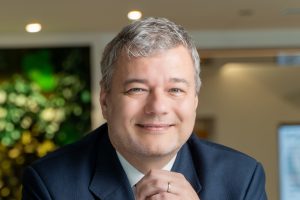
Ingo Brandenburg, managing director of Bayer Taiwan, brings over two decades of international pharmaceutical experience spanning Asia, Latin America, and Europe. With previous leadership roles, he has cultivated a deep understanding of cross-cultural business dynamics and healthcare system transformation. Since assuming his current role, he has spearheaded an ambitious organisational restructuring focused on agility, customer centricity, and employee empowerment whilst maintaining Bayer's position as a top-tier pharmaceutical presence in Taiwan's sophisticated healthcare market.
Having spent a year in Taiwan, how has your extensive international experience – particularly your time elsewhere in Asia and Mexico – informed your strategic priorities and leadership approach?
My background has been fundamentally international from the outset. My mother is Belgian, my father German, and this bicultural foundation instilled in me an inherent appreciation for cross-border perspectives and restlessness for new challenges and opportunities.
Every experience has prepared me for this particular moment in Taiwan. My career has encompassed both developing and developed markets, with the former predominating. This exposure to resource-constrained environments has cultivated an essential capability: fostering creativity and agility amongst teams. In smaller markets, one cannot rely on extensive manpower, necessitating innovative problem-solving approaches. This creative mindset has proven phenomenally valuable in Taiwan..
Naturally, my appointment represented a significant transition for the organisation. However, the team’s adaptability has been remarkable. What facilitated this integration was my prior experience living in Asia and understanding certain cultural nuances – approaches to interpersonal relationships, recognition, and communication styles. Had I arrived directly from Germany, the assimilation process would undoubtedly have been more challenging, both in terms of internal team dynamics and external customer engagement.
Interestingly, Mexico shares considerable cultural affinity with Asia regarding values and worldview – emphasis on family, health, and quality of life. These six years in Mexico, followed by 14 years across Asia, have substantially moderated my inherently direct German communication style. Taiwan is a high-context society, whereas Germany represents a low-context culture. This extended Asian experience has been instrumental in bridging that gap.
Creativity and cultural sensitivity have thus become my principal navigation tools here in Taiwan.
Bayer is undergoing a significant transformation under new global leadership. How is this manifesting at the local level, and how are you managing this evolution?
This transformation represents a perpetual journey guided by Agile principles and 90-day planning horizons. We embrace continuous improvement, aligned with a principle I have carried since university: “Good, better, best – never let it rest until the good is better and the better is best.”
Our evolution centres on two objectives: becoming genuinely customer-centric whilst unleashing employee potential. We are systematically “debureaucratising” operations, eliminating authorisation processes for expenses, holiday requests, and streamlining overtime tracking. The objective is to make the customer experience frictionless.
Structurally, we implemented a significant change this year: between every individual and me, only a maximum of one intermediary layer now exists. Previously, approvals required navigating five hierarchical levels; we now operate with three, dramatically reducing alignment requirements whilst placing substantial accountability on individuals. We cultivate psychological safety where decision-making and failure are acceptable, operating on a “fast fail or scale” principle with 90-day experiments measuring impact rigorously.
We bring these principles to life tangibly. I maintain no private office, sitting amongst colleagues daily. This enhances interpersonal engagement and knowledge sharing. Every 90 days, we conduct rigorous retrospectives examining what succeeded, underperformed, must cease, and should scale. When people recognise collective investment in shared success, we cultivate an enterprise mindset where everyone identifies the greatest impact opportunities.
We maintain one organisational goal cascading from country to regional to global objectives, mobilising everyone to capture identified opportunities. My supervisor’s recent visit confirmed considerable satisfaction with engagement levels and team spirit – something quite different from our historical approach.
We are deliberately departing from convention. Previously, leadership visits involved 60 PowerPoint slides; now, we utilise poster formats displaying only essential messages. Everyone participates in presentations across therapeutic areas, developing business acumen organisation-wide. Whilst no perfect organisational model exists, an entire organisation committed to improvement will eventually achieve it.
How would you characterise Bayer’s market position in Taiwan, and what are your strategic priorities from a portfolio perspective?
Bayer operates as a substantial conglomerate encompassing agriculture, consumer health, and pharmaceuticals, with enabling functions across all divisions reporting to me as Managing Director. My accountability structure is asymmetric: challenges escalate to me, whilst smooth operations remain the responsibility of divisional leadership. The Chief Financial Officer operates division-agnostically, ensuring comprehensive visibility across the business.
Certain priorities transcend divisions – health and safety and compliance represent core cultural commitments falling under my purview. Whilst I attend important customer events across consumer health and crop science, these serve primarily representative functions as we actively pursue operational synergies.
Our unique multi-divisional structure creates compelling partnership opportunities. Taiwan’s largest pharmacy chains engage with both pharmaceuticals and consumer health, necessitating unified company coordination rather than separate representatives. Similarly, farmers represent customers for our agriculture division whilst simultaneously constituting a critical population for healthcare education regarding self-care solutions and conditions such as prostate cancer.
Taiwan’s farming population is ageing markedly, yet prostate cancer awareness remains remarkably low. When detected, diagnoses typically present at advanced stages – predominantly stage three or four. Taiwanese men often perceive themselves as robust, seeing no need for medical consultation. Prostate cancer represents the fastest-growing cancer mortality specifically because men avoid screening, contrasting sharply with breast cancer, where women demonstrate substantially greater awareness and proactive engagement.
We have formalised strategic partnerships with multiple associations and hospital networks through Memoranda of Understanding signed in this office. Our partners include Formosa Cancer Foundation, Oncology Nursing Society, Institute of Cancer Research, National Health Research Institutes (NHRI), Taiwan Association of Cancer Research, Taiwan Urological Oncology Association, Formosa Cancer Foundation, HOPE Foundation for Cancer Care, and Taiwan Oncology Nursing Society. We are pursuing cultural mindset transformation through physician and patient advocacy partnerships, creating collaborative websites and LINE communication groups providing warning signs, practical guidance for living with prostate cancer, and related resources. We can arrange prostate cancer specialist presentations for farmers, nutritional supplementation discussions by nurses, and integrate capabilities across our distinctive three-business-unit structure.
The collaboration between pharmaceutical personnel engaging physicians and agriculture specialists working with farmers – vastly different professional profiles – proves genuinely rewarding to observe. Whilst I do not directly manage these divisional operations, I drive synergies, maintain foundational operational standards, and ensure leadership alignment, because coordination across our unique portfolio remains essential.
In terms of consumer health and pharmaceuticals, how significantly does the Taiwan organisation contribute to the Asia-Pacific performance?
Taiwan’s market ranks within the top five overall across Asia-Pacific. Taiwan embodies our “Health for All” principle through its universal healthcare system, though demographic pressures from ageing populations and declining birth rates create sustainability challenges as fewer individuals contribute to funding pools whilst treatment demand increases. Professor Shih has been instrumental in directing government healthcare investment into priority areas, including the Cancer Fund.
Taiwan represents a critically important market where we deploy our entire portfolio, contrasting with largely out-of-pocket markets such as Vietnam or the Philippines, where speciality solutions prove prohibitively expensive. Many patients travel to Taiwan specifically for oncology, given its status as a major cancer clinical research centre.
Bayer Taiwan participates in all clinical studies conducted here, capitalising on excellent infrastructure, sophisticated data exchange, and available patient populations. Our clinical trial footprint remains substantial, concentrating on oncology and cardiovascular research. Our strategic partnership with Taipei Medical University exemplifies this commitment.
Oncology and cardiovascular disease – encompassing all cardio metabolic therapies – represent our stronghold for over 25 years. Beyond our largest product globally, we are advancing our product for chronic kidney disease with anticipated heart failure indication approval in January. We are introducing an oral therapy for prostate cancer with expanded labelling permitting administration without chemotherapy, addressing chemotherapy-resistant patients and varying metastatic burdens. This month brought indication extensions for our contraceptive portfolio, supporting our broader women’s health initiatives.
Women’s health has emerged as an area of increasing focus. How is Bayer Taiwan advancing this agenda, both medically and societally?
One of my initial initiatives was the Endometriosis Alliance event hosted in March– an “Anything but Normal” programme developed in partnership with the Gynaecology Association and patient advocacy groups, significantly elevating endometriosis awareness. Many women experience menstrual pain and cramping, assuming it represents inevitable suffering, yet a genuine physical condition underlies these symptoms, with available therapeutic solutions. We have been the market leader in endometriosis treatment for ten years, supporting increasing numbers of women seeking treatment rather than accepting monthly symptoms that significantly impair quality of life.
The societal impact proves substantial in contexts of declining workforce participation. When productivity decreases due to these symptoms – rendering women unapproachable, unproductive, unable to work or attend school for days – the economic consequences are considerable.
We partner extensively with women’s health associations, celebrating International Women’s Day, conducting Endometriosis Awareness Month activities in March. Whilst this may not represent our primary business focus, constituting a smaller portfolio portion, we maintain corporate responsibility as Bayer.
One of our three overarching sustainability objectives is enabling 100 million women to benefit from Bayer healthcare solutions – contraception, endometriosis treatment, and menopause therapies. The second addresses 100 million smallholder farmers cultivating modest plots, reducing input costs whilst increasing yield through climate-resistant crops and digital solutions advising optimal planting times. The third provides 100 million economically disadvantaged individuals with access to essential consumer health solutions beyond cosmetics, medicated products, and self-care essentials.
When global leadership defines these priority areas, even when they do not constitute our primary business focus, we maintain duty and responsibility to engage with these populations. Women’s healthcare remains important for Bayer’s broader mission.
Where do you see Taiwan’s strategic strengths, and in which areas do you anticipate further opportunities for Bayer to invest or collaborate – particularly in digitalisation, data, or biotechnology?
When I consider Taiwan’s trajectory, semiconductors obviously constitute the economic foundation, with ten percent of overall national energy consumption attributable to one company. What I admire is Taiwan’s refusal to limit itself to semiconductors. They aspire to become a powerhouse in two additional sectors: artificial intelligence and biologics, establishing biotechnology parks designed to attract investment. The Mayor of Taipei demonstrated tremendous enthusiasm regarding his vision for these developments during our discussions.
Bayer fits through continuing the clinical trial network we have established, bringing trials to Taiwan and providing early access to innovative medicines – typically three to four years before market authorisation. When drugs prove effective in trials, some patients continue receiving medication through our continued provision until formal approval.
We will continue bringing innovations across cardiovascular, oncology, and ophthalmology. Our largest ophthalmology product exemplifies this commitment. We recently introduced the high-dose eight-milligram formulation, substantially more potent in treating macular degeneration with a longer duration of action compared to our previous two-milligram dose.
This medication requires intraocular injection, which, whilst unpleasant, proves necessary to prevent blindness. Extending durability from monthly to bimonthly or quarterly administration significantly reduces patient burden. We introduced a high-dose version with reimbursement approval in May, currently listing it in hospitals whilst maintaining the two-milligram formulation for appropriate patient populations.
Beyond clinical trials and medical innovation, what additional strategic priorities are guiding your agenda for Taiwan?
Bayer has made strategic acquisitions historically in cell and gene therapy, including Parkinson’s disease programmes. Whether and when these come to Taiwan, I cannot specify. However, regarding our immediate future, priorities are oncology, ophthalmology, cardio, and kidney metabolic medicine.
When considering launching innovation and conducting clinical trials, how do you ensure Taiwan maintains visibility and advocacy on a global scale within your organisation?
I have discussed the established network infrastructure here, the clinical trial capabilities, the operational efficiency, and patient availability. Recruitment in Taiwan proceeds remarkably smoothly, and globally, everyone recognises this. Taiwan is already on the map – not because of my individual efforts, but because this has been cultivated over time.
My responsibility is ensuring Taiwan remains on that map. However, this does not demand excessive attention because the global clinical team – hence their designation – maintains an operational presence here. I am in contact with these colleagues, who are based in our office. Whenever questions arise, people reach out to me, though fortunately, this occurs infrequently.
When regional or global clinical leaders visit Taiwan, I engage with them, emphasising the importance of this market. That is how I ensure continued focus. Taiwan is firmly established on the map, which is precisely where it should be.
Now, across the company, we are all exploring artificial intelligence solutions. On one hand, what can we offer customers? How can we enhance customer engagement? On the other hand, how can we streamline our internal processes? How can we employ AI for innovation? This is likely where all my colleagues globally are positioned as well.
We have dedicated design teams – mission teams that examine business challenges and develop solutions. Regional and global networks exist. In Taiwan, we have at least two colleagues who are absolute AI experts contributing on a global scale. However, we are all taking initial steps. We are in the learning phase. I am personally learning – taking those very first steps. That is acceptable regarding digital and AI capabilities.
Ultimately, we want digital solutions that work. Alternative engagement channels like LINE have proven very effective. However, success depends on content creation, because customers receive numerous LINE messages. Your content must be engaging, so we maintain intense focus on what genuinely matters.
Some physicians may not prefer certain content types, but we identify this through data analysis. We must examine which customers prefer which channels and which content within those channels. That is why we must analyse data continuously – again, on a ninety-day cycle – to improve further in the next ninety days.
You may find this repetitive, but we measure customer engagement: How many customers are we reaching? Are they opening messages? Are they clicking through? How long do they engage? Which content types resonate? This informs our content development strategy because content is paramount. Relationships matter. Science matters. How do you synthesise relationships and science? Through content.
On a personal note, what continues to motivate you after a long career leading organisations across multiple global markets?
What motivates me at the core is witnessing people grow. Because we are now so interconnected, everyone learns. I learn from my colleagues; they learn from me. We develop these 90-day plans with our aspirations and objectives, then we celebrate success together. That is what motivates me.
Everything at Bayer centres on our largest product, a factor Xa inhibitor anticoagulant. We experienced a 50% price reduction this year. You can imagine we are currently operating at a deficit. It is about mobilising the entire organisation, focusing on the right opportunities to restore growth. That represents an energising challenge for me and keeps me fully engaged.
People energise me. Some individuals lose energy through interpersonal interaction; I gain energy from people. I may not conform to conventional expectations, but I feel absolutely suited for Bayer at this moment – cultivating customer proximity, maintaining closeness with our people, genuinely improving our customer engagement, and eliminating everything tedious.
This sounds perhaps amusing, but it is authentic. I become disengaged when I must navigate approval processes, when my assistant informs me I must authorise something. That is not where I want to invest my time. Absolutely not.
We have numerous positive developments to communicate. Together with our communications colleagues, we have initiated regular external communication, focusing on image and reputation. We are constructing something unique here and aspire to be recognised as unique and attractive because of that uniqueness. That is what we want to achieve, and the team is actively leveraging me towards this goal as well.
As a final thought, is there a message you would like to leave with our readers regarding Bayer’s partnerships and long-term commitment in Taiwan?
I wish to emphasise our partnership with Taipei Medical University, whose campus I observe daily from our office. This represents an unusual partnership where meaningful outcomes emerge rather than merely ceremonial Memoranda of Understanding.
It commenced with real-world evidence generation through collaborative data mining of their patient database, examining thousands of patient records to identify which cardiometabolic treatment protocols produce optimal patient outcomes. Clinical trials represent one dimension; observing performance in Taiwanese patients in authentic clinical practice provides another. We have pioneered this approach, with increasing interest from other countries wishing to join our alliance and contribute data, expanding our ecosystem.
We maintain proximity to academia through university presence. Students visit our facilities to understand pharmaceutical company operations. We host interns embedded in product teams, gaining comprehensive exposure and actual responsibilities within our ninety-day operational cycles.
Professor Wu initiated this partnership, which I inherited from my predecessor, and it continues to deepen through mutual commitment to optimal patient outcomes. We possess real-world evidence generation capabilities; they possess the data. This synergy elevates collaboration to an entirely new level. We recently discussed conducting meetings at the university campus to provide our people with an environmental context, whilst inviting them to utilise our facilities. This represents a genuinely living partnership.
We remain perpetually open to like-minded partners who prioritise patient interests and with whom we can synergise capabilities effectively.