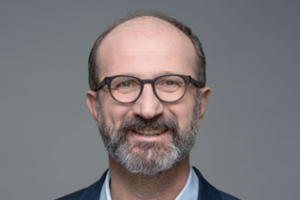
Frederic Collet, Chairman of FIAC (La Filière Intelligence Artificielle et Cancers), leads a pioneering public-private consortium bringing together nine of the world’s most innovative oncology companies with France’s public health institutions. Drawing on extensive oncology expertise and a deep commitment to national competitiveness, he champions a unique model in which traditional rivals collaborate on AI-driven cancer research, co-financing initiatives with the government and channelling half of all project funds into strengthening France’s start-up ecosystem.
Where does French healthcare currently stand from an international perspective today? What shifts or trends are most significant?
All major healthcare systems are wrestling with the same structural equation: the pressures of demography, the accelerating pace and changing nature of innovation, and the increasing influence of global interconnectedness on both supply and demand. Demography lies at the root of almost every strategic issue the sector faces. Innovation forms the second element of this equation, evolving from scientific breakthroughs to technological progress and now decisively towards data-driven transformation. The third component, globalisation, reshapes markets, expectations, and the competitive environment.
What is most striking is the diversity of national responses. France, owing to its own historical, political, social, and economic characteristics, has taken a path distinct from Germany, the UK, the US, and other peers. In 2023, at the request of the former Prime Minister, E.Borne, I participated in a report about the financing of the healthcare product named “for a new deal securing equitable and durable access of healthcare products to all patients”. It sets out a clear diagnosis, a set of shared convictions, and a range of recommendations. The diagnosis and general direction were met with broad consensus, even though the recommendations did not attempt to be exhaustive.
Several measures are now underway. Yet the core proposition of the report – its call for a “New Deal” – has not been fully adopted. At this stage, selective implementation is insufficient. If there is one point I would underline, it is that innovation is the solution. In a world of rising needs, innovation is not a burden; it is the essential answer. France must ensure genuine, timely access to innovation in every dimension – scientific, technological, and data-driven – while remaining faithful to the principles of its social contract.
Access to innovation while safeguarding financial sustainability remains a central challenge. What steps must France take to remain competitive and attractive to international investment?
Attractiveness and sustainability are entirely interdependent. France must remain a place where innovation is welcome and where innovators can operate across the entire value chain, spanning research, development, industrialisation, market access, and commercial deployment. The whole value chain has to be considered and secured in a coherent way, all along and not piece by piece. A sustainable healthcare system ensures patients can access innovation without jeopardising long-term viability.
To protect our system, every stakeholder must assume greater responsibility, particularly in addressing inefficiencies that have accumulated over time. France has historically favoured incentives over constraints to encourage progress. Many of these incentives were appropriate for a previous era but no longer reflect contemporary realities. This affects every actor across the system, including patients, healthcare practitioners, industry, and payers.
There is a need to strengthen efficiency while also reinforcing the sense of shared responsibility. We must clarify what should legitimately be supported by the community and what should not. Sustainability will depend on how we, collectively – as patients and as actors – take ownership of the system. Given that roughly 80% of healthcare spending in France is publicly financed, the importance of this shared responsibility cannot be overstated.
Ultimately, the world has changed because innovation has changed. The central issue today is access to innovation. France must reassess its entire approach and ensure that actions are coherent, coordinated, and aligned with the changing environment in accordance with public healthcare priorities.
How did you come to be involved with FIAC, and what motivated you to take on this voluntary leadership role?
My involvement began quite straightforwardly: I was invited to join. I accepted because the initiative aligned closely with my experience in oncology and with my commitment to strengthening France’s attractiveness and competitiveness. Although the position is voluntary, I regard it as a genuine public and professional commitment.
When I was approached, the project was still emerging and carried a certain degree of uncertainty, but I was convinced that I could bring my experience to contribute meaningfully to its development and ultimate success.
Could you describe FIAC and share your perspective on the current data landscape?
To understand FIAC, one must start with the nature of data itself. Innovation has shifted from science to technology and is now anchored in data. The data environment remains relatively immature, whether in terms of access, security, or governance. At the same time, it comprises a wide variety of actors. Much of the data is held by public institutions and represents a national asset. France’s heritage in this domain is particularly strong, thanks to the SNDS, the longstanding cancer registries, and decades of systematic health data collection. As the historical pilot of the national Cancer strategy, INCa is also in charge of an exceptional and internationally recognised data resource (Cancer Platform and now national Registry). As such it is a critical actor for any IA development in oncology in France.
Private actors range from major global companies to highly innovative local start-ups. The conclusion became clear: to strengthen both research and economic competitiveness, it was essential to bring these actors together within a structured framework. FIAC achieves precisely this, uniting public and private stakeholders under a common governance contract. This approach has been recognised internationally for its originality and power.
The model is founded on the principle of proving value through concrete projects. Competitors and actors with complex public-private relationships sit together, jointly select projects together, share methodologies together, and co-own results together. No single party holds exclusive rights. Funding is equally split between nine leading oncology companies and a public body. A large part of the initial funding is being used to INCa data platform, and the rest goes to project development. Half of the money we spend on these projects goes to the start-up ecosystem, enhancing, therefore, France’s attractiveness and competitiveness.
FIAC’s methodology, although simple, is powerful and potentially transferable to other fields. It relies on a public reference actor – in oncology, this is INCa (The National Cancer Institute) – paired with a high-quality data source such as the SNDS and oncology-specific registries, and an ecosystem of stakeholders ranging from major companies to innovative SMEs. Created four years ago, FIAC has now proven its concept with nearly fifteen projects underway, several already published on international platforms such as ASCO and ESMO.
Looking ahead, what are FIAC’s key priorities and next steps as it advances its mission?
With the proof of concept firmly established – demonstrated through the quality of research outputs and the successful mobilisation of a diverse ecosystem – FIAC is moving into a phase of expansion. The ambition is to at least to double the number of projects in the coming years, applying the same collaborative methodology that has characterised its early success. In practice, this means three priorities: refining our value proposition, launching a first Europe-level flagship, and industrialising Natural Language Processing-based real-world data extraction.
The consortium also aims to broaden participation. Companies may join to draw on FIAC’s experience in areas such as patient pathways, access to innovation, or AI-driven cost-of-care analysis. Others may join as full partners, bringing expertise in oncology, data science, patient access, or clinical research.
AI is opening considerable new opportunities in areas such as digital clinical trial arms, AI-enabled data collection, enhanced patient pathway mapping, and strengthened mechanisms for data acceptance. The field is extremely fertile, and FIAC is well-positioned to continue shaping its development.
The forward agenda, therefore, centres on expanding the volume of projects, diversifying partner participation, deepening public-private coordination, and reinforcing France’s position as a competitive hub for data-driven oncology research.
AI has become a strategic priority for global industry leaders. How does France position itself in this field, and how does FIAC contribute to national objectives?
FIAC originated from the state-led “Conseil Stratégique de Filière”, which designated AI and health as areas of national strategic interest. During FIAC’s most recent national conference on 4 September, two ministers – Health and Industry – attended together, an event that is rare in France. Their presence underscored the strategic significance of FIAC’s work in developing AI capabilities, improving access to national data assets, and strengthening national sovereignty.
Sovereignty has got to be considered through two dimensions: protecting national assets and making them attractive to international partners. FIAC plays a central role in both coordinating public and private actors, attracting major global companies, and nurturing a vibrant ecosystem of French start-ups specialising in data and AI. This builds on France’s strong legacy in health data management.
Looking ahead, two strategic questions arise. First, can FIAC remain solely a national initiative, or should its learnings be expanded to the European level? Given the success of its collaborative architecture, there is clear potential for European application. Second, can this model – built on a reference public actor, a trusted data source, and a coordinated ecosystem – be applied to other therapeutic areas? Fields such as rare diseases are already exploring how to adapt FIAC’s approach. This, ultimately, is what makes FIAC so distinctive.