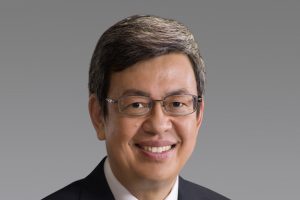
Epidemiologist Dr Chen Chien-jen has spent decades at the intersection of scientific research and public health policy. His pioneering work on arsenic-induced health hazards informed international water safety standards, whilst his leadership during the SARS outbreak established Taiwan's pandemic preparedness infrastructure. In this wide-ranging conversation, Dr Chen discusses Taiwan's approach to ageing populations, the evolution of precision medicine, and the nation's emerging role in global biopharmaceutical innovation.
Could you begin by introducing yourself and your multifaceted career spanning academia, science, and public service?
I consider myself fundamentally both a scientist and a public servant – two roles that have become inseparable in my career. My scientific work centres on epidemiology, particularly examining how environmental and biological hazards affect human health at the molecular and genomic level. Our research on arsenic contamination in drinking water, for instance, provided the evidence base that prompted the World Health Organisation and the US Environmental Protection Agency to lower safety thresholds from 50 parts per billion to 10 parts per billion based upon our Taiwan studies.
What proved particularly fascinating was discovering why some individuals exposed to arsenic develop cardiovascular disease or cancer whilst others remain relatively unaffected. We identified both acquired vulnerabilities – inadequate folic acid intake being one – and genetic factors, particularly the body’s capacity to methylate and detoxify arsenic. These insights emerged from rigorous, long-term epidemiological work.
The biological side of our research follows a similar philosophy. Since 1991, we have tracked a cohort of approximately 24,000 individuals, building a comprehensive picture of how viruses like hepatitis B and C, along with bacteria such as Helicobacter pylori, contribute to cancer development over decades. This patient data allowed us to identify predictive biomarkers – essentially early warning signals that help clinicians intervene before disease progresses.
Our hepatitis B work exemplifies how research translates into practice. When we published findings in the New England Journal of Medicine and JAMA showing that viral load and e-antigen status could predict liver cancer risk over five, ten, even thirty years, hepatologists initially felt overwhelmed by the complexity. So we developed a risk calculator – now AI-assisted – that guides treatment decisions: which patients need immediate antiviral therapy versus those requiring only monitoring. This fundamentally changed how chronic hepatitis B is managed worldwide.
When I joined the Ministry of Health in 2003 during the SARS crisis, we implemented nationwide antiviral therapy based on this evidence. The results speak clearly: liver cancer mortality has fallen by approximately 50 percent. Taiwan was once called the “island of liver diseases.” Changing that designation required not just laboratory discoveries but the courage to step into public service and implement what the science revealed. That journey from research bench to national policy has defined my career.
That progression from research to implementation demonstrates remarkable impact. Your mention of SARS naturally leads to that pivotal period. Could you elaborate on Taiwan’s response to that crisis?
SARS arrived in Taiwan in 2003, spreading from Guangzhou through Hong Kong to several regions – Taiwan, Hanoi, Toronto, Singapore. With no antivirals or vaccines available, we returned to what I call the ABCs of infectious disease control: border quarantine, early identification, and contact tracing. The identification piece was relatively straightforward because SARS announced itself with high fever. We established nationwide temperature screening – twice daily for schoolchildren and workers entering and leaving their institutions. It was comprehensive, though admittedly requiring significant public compliance.
SARS is not particularly clever as viruses go. It requires prolonged, close contact for transmission, which meant most cases occurred amongst healthcare workers, patients, and their families. We documented 364 probable cases, and initially Taiwan seemed secure with no community spread. Then Taipei Municipal Heping Hospital experienced an outbreak when a laundry worker, showing fever but lacking travel history, was not immediately suspected. The infection cascaded through hospital contacts, ultimately affecting six hospitals. That was our crisis moment.
I was appointed Health Minister on 18th May, essentially told I needed to enter the volcano. We moved immediately on three fronts: upgrading hospital infection control across all 500 facilities through a cascade training model, establishing “fever walls” – dedicated negative-pressure isolation pathways separating high-fever patients from others – and creating fever screening clinics. Within three weeks, we stopped new cases. By June, SARS was contained.
I thought my work was finished, that I could return to National Taiwan University. The Premier had other ideas: “Are we prepared for the next pandemic?” We were not. So I spent eighteen months redesigning Taiwan’s entire pandemic infrastructure – revising legislation, reorganising the Ministry of Health and CDC, establishing infectious disease response systems. It was exhausting but, as it turned out, extraordinarily prescient.
When COVID-19 emerged in Wuhan on 31st December 2019, we knew exactly what to do. Johns Hopkins’ AI models predicted Taiwan would be the second-worst affected nation. Instead, by October 2020, the US National Bureau of Economic Research reported we had achieved the lowest COVID mortality and the lowest economic loss amongst 40 countries analysed. Our economic loss was actually negative – we grew. No city lockdowns, no travel bans, just contact tracing and home quarantine. Over 250 consecutive days of zero local transmission in 2020. The world called us an anomaly.
The secret, if there is one, lies in public trust. During SARS, 75 percent of our 23 million citizens voluntarily measured their temperature twice daily. That is democracy working. When I testified before the UK Parliamentary Committee, they were astounded to learn that of one million people we quarantined at home using mobile phone monitoring, only 0.2 percent violated the rules. That is 99.8 percent compliance – not through authoritarianism but through transparency. Our Central Epidemic Command Centre held daily press conferences, shared everything openly, concealed nothing. Citizens trusted the information, so they trusted the measures. Schools stayed open, businesses operated, life continued.
Of course, COVID-19’s global duration eventually required vaccines and therapeutics. The speed of mRNA vaccine development – ten months versus the typical 15 years for traditional vaccines – was extraordinary. Yet we faced our own challenge with vaccine hesitancy, particularly amongst the elderly. Misinformation from authoritarian sources suggested vaccination carried greater mortality risk than the virus itself. Given Taiwan’s proximity to China, this disinformation found fertile ground. Our elderly vaccination rates lagged behind Japan and Korea’s 80 percent well into 2023. It remains a reminder that openness, whilst essential for democracy, also creates vulnerabilities to deliberate disinformation campaigns.
Taiwan’s healthcare system frequently ranks first globally. Whilst much functions exceptionally well, challenges including population ageing persist. If you were Health Minister today, what reforms would you prioritise?
Population ageing is the defining challenge – we face both exceptionally low fertility rates and extended lifespans, meaning approximately 20 percent of our population is now elderly. This creates twin pressures: healthcare complexity and long-term care demands.
Our post-SARS reforms actually anticipated this somewhat. We now require all medical graduates to complete two years as general practitioners before specialising. When you are treating an 80-year-old with hypertension, diabetes, high cholesterol, and perhaps early dementia, you need physicians who understand the whole patient, not just isolated conditions. The same philosophy applies to nursing education – geriatric care requires different skills and sensibilities.
But healthcare is only half the equation. For elderly care, we deliberately rejected the institutionalisation model. We do not want rows of nursing homes. Since 2016, our Long-Term Care Programme 2.0 has established over 10,000 community day-care centres – think of them as kindergartens for seniors, if you will. Elderly individuals can spend their days with activities, exercise, social interaction, receive lunch and perhaps dinner to take home, then return to their own homes and families by evening. For those who prefer staying home entirely, we provide visiting nurses and care workers once or twice weekly, depending on need – help with cleaning, medication monitoring, that sort of practical support. Everyone has a case manager they can contact.
We have created a three-tier system: these local C-level centres for daily care, B-level rehabilitation clinics for more intensive needs, and A-level facilities attached to medical centres for severe disability or advanced dementia. The choice between home-based and institutional care remains with families. It is about integrating healthcare with what I call life-care – recognising that quality of life matters as much as medical intervention.
Our universal health insurance covers 99.9 percent of citizens with comprehensive benefits – dental care included – and minimal co-payments. A community clinic visit costs about seven US dollars. This accessibility partly explains our global rankings, but it also creates sustainability pressures as our population ages and disease complexity increases.
So we have shifted from fee-for-service to pay-for-performance. Physicians managing chronic conditions – diabetes, hypertension, kidney disease – now receive enhanced reimbursement when their patients actually improve: regular testing, lifestyle modifications, weight reduction. If patients deteriorate, compensation reflects that. It aligns incentives with outcomes rather than volume.
This embodies what Dr Leroy Hood of the US National Academy of Sciences calls P4 Medicine. Preventive – stopping disease occurrence and progression. Predictive – using biomarkers and risk factors to forecast who faces cardiovascular disease or stroke risk. Personalised – tailoring treatment to individual risk profiles rather than one-size-fits-all protocols. Participatory – engaging patients in their own health management, which we incentivise with health vouchers worth 600 to 800 New Taiwan dollars monthly (USD 19 to 25) for those who comply with recommendations.
We have expanded cancer screening across cervical, breast, colorectal, lung, liver, and gastric cancers. Yet some patients still develop advanced disease requiring immunotherapy or cell therapy they cannot afford. When I was Premier, we established a cancer new-drug fund of 500 million New Taiwan dollars (16 million USD) annually within our Healthy Taiwan Programme, ensuring financial barriers do not prevent access to cutting-edge treatments.
Population ageing is a formidable challenge, but the P4 framework – preventive, predictive, personalised, participatory – gives us a viable path forward. It requires rethinking healthcare as a continuum rather than episodic intervention.
Where do you see Taiwan’s competitive edge in terms of scientific potential globally?
We began thinking seriously about this in 2007. Taiwan had already built world-class information technology and semiconductor industries in our science parks. But biopharmaceutical development lagged behind. So we took a three-pronged approach: infrastructure, incentives, and talent.
First, we established dedicated biomedical science parks – Hsinchu, facilities here at Academia Sinica – creating clusters where start-ups could grow. Second, we enacted the Pharmaceutical Development Act in 2007, extended for another decade in 2017, providing meaningful incentives for investors entering biopharmaceutical development. Third, we passed legislation allowing university scientists to serve as CEOs or senior advisors to start-ups, encouraging translational research. Previously, this was discouraged. We also introduced gold cards for foreign talent – permanent residence after just two years now – to address our persistent shortage of biomedical expertise.
But we face an inherent constraint: population size. Any pharmaceutical company developing products in Taiwan cannot survive on our domestic market alone. This forces an international perspective, which is actually advantageous. We have worked to harmonise our FDA evaluation systems with international standards, particularly the US, making regulatory pathways more predictable for companies aiming at global markets.
Where Taiwan truly excels is in areas that leverage our existing strengths. Medical devices and diagnostics, for instance, benefit enormously from our semiconductor and ICT capabilities. Internet of Things healthcare devices – we manufacture these successfully at scale. For clinical trials, we established Clinical Trial Consortium Taiwan in 2008, which transformed our landscape. Physician-initiated Phase I trials, particularly for oncology, increased dramatically, as did Phase II and Phase III studies. We now train physicians to lead multinational trials, positioning Taiwan as a regional hub for Asian populations. The economics help considerably – our lower living costs make trials more affordable than Japan, the EU, or the US, whilst maintaining world-class infrastructure and expertise.
The real opportunity lies in artificial intelligence. We possess two critical advantages: our universal health insurance system contains data from all 23 million citizens – not just reimbursement records but comprehensive imaging and laboratory results – and our major medical centres have implemented sophisticated AI systems for everything from imaging interpretation to nursing shift optimisation. Yes, even scheduling nurses efficiently requires complex AI – it sounds mundane but dramatically affects retention.
Companies like Google and NVIDIA have established AI centres in Taiwan. Google runs a substantial health AI operation in New Taipei City; NVIDIA is building one in Taipei. Here at Academia Sinica, our president mandated that all principal investigators complete AI training. Google’s health specialists teach these courses, which creates fascinating exchanges. They possess AI expertise but lack domain knowledge – genomics, proteomics, metabolomics. We have the biological understanding; they have the computational tools. It is genuinely collaborative. AI can accelerate molecular docking for drug discovery, viral variant tracking, imaging analysis – the applications are transformative.
Taiwan may not lead AI development yet, but we aspire to. We have the data infrastructure, the medical expertise, and increasingly, the partnerships to make meaningful contributions.
To conclude, what message would you convey to an international audience? What collaborative opportunities do you see?
I believe pharmaceutical development and beneficial healthcare initiatives absolutely require international collaboration. Taiwan possesses extensive experience in international collaboration across clinical research, medical research, and biochemical research. My own studies have been predominantly international collaborative endeavours. We maintain substantial experience in this domain.
For industry specifically, we must encourage our companies to extend collaborations with enterprises globally. This proves essential. Taiwan’s Contract Development and Manufacturing Organisation sector, for example, maintains excellent connections with resilient CDMO companies in the US. This technical collaboration proves absolutely essential.
We welcome all industries – foreign companies – to establish collaborations with Taiwan. This will unequivocally create mutually beneficial situations. Although this may not represent an ideal example, I shall mention Taiwan’s domestically developed COVID-19 vaccine, Medigen. According to Taiwan CDC analysis, whilst Medigen employed the same genetic construct as Moderna – Moderna being an mRNA vaccine whilst Medigen is a protein subunit vaccine – following implementation in Taiwan, Medigen demonstrated efficacy comparable to Moderna, derived from identical genetic constructs, and proved superior to certain alternatives. Unfortunately, due to political interference, the vaccine did not achieve commercial success. However, this exemplifies that utilising identical technology platforms, Taiwan can collaborate with the US National Institutes of Health to develop sophisticated capabilities. We also maintain collaboration with the NIH on HIV vaccine development. This international cooperation proves tremendously important to Taiwan.
We strongly encourage international partnerships. We welcome collaboration with Taiwan.