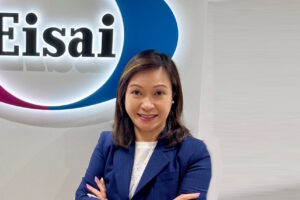
Andrea Chang, general manager of Eisai Hong Kong explains the importance of the firm’s FDA-approved Biogen-partnered Alzheimer’s disease (AD) product, particularly in Hong Kong where some 20 percent of the population is aged 65 or older. In addition, she outlines Eisai’s oncology and neurology-focused portfolio; the potential provided by Hong Kong’s new the 1+ system, and Eisai Hong Kong’s plans to become more active in clinical trials.
What was your motivation to join Eisai in 2022 for your first general management role?
My decision to join Eisai was fuelled by the promising developments in Alzheimer’s disease (AD) research. The opportunity to work in a therapeutic area with such a high unmet need was compelling. Alzheimer’s not only affects patients profoundly but also impacts their families, caregivers, and healthcare professionals. The recent FDA approval of our Biogen-partnered Alzheimer’s product (Lecanemab), after extensive research efforts spanning decades and involving multiple compounds, was a pivotal moment. It signified a breakthrough in the field. In Hong Kong, Eisai acts as the sole actor for this product’s commercialisation while maintaining close collaboration with Biogen for strategic updates and regulatory alignment.
Our corporate ethos revolves around putting patients first in everything we do. This philosophy extends beyond merely meeting sales targets; it is about understanding and addressing the needs of patients and their caregivers across various therapeutic areas. We dedicate a significant amount of time—approximately 16 mandatory hours annually per employee—to engaging directly with patients, ranging from those battling cancer to those managing neurological conditions like epilepsy, Parkinson’s disease, and multiple sclerosis. These interactions provide invaluable insights that shape our approach in sales, marketing, and medical support, enabling us to better serve patients’ needs and enhance their overall satisfaction with our products.
How do patient interactions influence your operational strategies in Hong Kong?
Our interactions with patients have been instrumental in refining our approach to patient support and disease communication. For instance, in diseases like multiple sclerosis, which can be complex to understand, patient feedback highlighted the need for clearer disease awareness programmes and educational materials. Patients often struggled with technical medical jargon, so we revamped our patient information leaflets to ensure they are accessible and understandable. This initiative not only empowered patients with better information but also improved adherence to prescribed treatments.
Could you elaborate on Eisai’s current portfolio here in Hong Kong?
Eisai’s portfolio in Hong Kong focuses on two primary therapeutic areas: oncology and neurology. In oncology, we initially focused on breast cancer and hepatocellular carcinoma (HCC), or liver cancer. Looking ahead, our future oncology initiatives will expand to include women’s health cancers such as ovarian and endometrial cancers.
In neurology, our portfolio encompasses a diverse range of conditions including Parkinson’s disease, epilepsy, Alzheimer’s disease, insomnia, neuropathic pain and multiple sclerosis. Notably, our multiple sclerosis products are in collaboration with Biogen, further enhancing our capabilities in this area.
How have you drawn on your prior experience in oncology in your current role and how is this therapeutic area being factored into reimbursement here?
Oncology, like all our therapeutic areas, is all about access, ensuring our treatments reach the patients who need them. At Eisai Hong Kong, I have focused on stakeholder engagement, particularly with NGOs for patient assistance programmes, a strategy I honed from my previous experience in this industry.
Additionally, negotiating with the government to include our products in the formulary has been pivotal for enhancing accessibility. Since joining Eisai Hong Kong, I have prioritized securing local approvals for all indications to accelerate our market presence.
In Hong Kong, reimbursement for oncology treatments follows a structured approach that considers efficacy, safety, and impact on quality of life as primary criteria. We referenced assessments from the UK, Australia, South Korea, and Taiwan to guide reimbursement decisions. In addition, assessing total budget impact alongside international cost-effectiveness analyses, such as those conducted by NICE in the UK and PBS in Australia.
How do you navigate the complexities of pricing negotiations?
In Hong Kong, demonstrating cost-effectiveness involves presenting comprehensive data on outcomes such as overall survival, progression-free survival, and quality of life. These factors are crucial because while extending life is important, maintaining or improving the quality of life for patients is equally vital. Therefore, our approach involves not only meeting regulatory and safety standards but also ensuring our treatments provide tangible benefits that resonate with both patients and healthcare providers.
Assessing quality-of-life endpoints in clinical studies is a major challenge; how are you approaching this in Hong Kong?
In Hong Kong, we rely primarily on international data, often from studies conducted in Japan, the US, or Europe, to assess quality of life endpoints in clinical evaluations. Historically, Hong Kong has not conducted extensive studies specifically focusing on quality-of-life measures within local clinical settings. However, there is a growing trend towards incorporating quality of life scaling into studies globally, which helps in better reporting and understanding of patient experiences across different regions.
Regarding reimbursement across our portfolio, most of our oncology product indications have been successfully reimbursed in Hong Kong. This is crucial because approximately 70 percent of cancer patients in Hong Kong seek treatment within hospital settings, where reimbursement plays a pivotal role in ensuring access to necessary treatments. While reimbursement primarily targets less financially comfortable patients, there is a segment termed “sandwich class patients” who may not qualify for full government subsidies but still require support. To address this, we collaborate closely with NGOs to implement patient assistance programmes tailored to support these individuals, ensuring broader access to our treatments across different economic strata.
One key learning for me has been the critical importance of effectively leveraging our clinical data to create compelling value propositions for the government. Unlike previous experiences in oncology, where clinical data interpretation was also crucial, the depth of engagement required with local stakeholders here in Hong Kong has underscored the significance of our medical department. We are a highly data-driven company, and our ability to translate complex clinical findings into persuasive presentations has been pivotal. The support from our global team in this regard has been substantial, yet locally, the role of the medical department in interpreting and presenting data is paramount. This not only enhances our product understanding but also strengthens our ability to demonstrate the value of our treatments effectively to government bodies and stakeholders.
Can we speak about neurology, an area that is extremely important and also challenging for policy makers, companies and patients alike, and discuss Eisai’s portfolio?
Neurology is indeed a challenging field, and Eisai has a robust portfolio dedicated to addressing these challenges. Our commitment to neurology spans decades, with a particular focus on Alzheimer’s disease. Over the years, our persistence has been unwavering as we strive to discover more effective treatments. Our latest product represents a significant advancement as an anti-amyloid drug, marking the dawn of a new era in Alzheimer’s treatment.
Looking ahead, we have also got an anti-Tau medication in our pipeline., as we understand that there are multiple facets to Alzheimer’s pathology, addressing both amyloid beta and Tau protein accumulations are essential.
By investigating these mechanisms, we are not only advancing our own understanding but also contributing to broader scientific knowledge in the industry. At Eisai, we are responsible for ensuring that healthcare professionals and patients understand how to use our products appropriately. It is important to clarify that our treatment is not a cure. It is indicated primarily for early Alzheimer’s disease and mild cognitive impairment (MCI) due to AD. MCI refers to a stage where cognitive abilities decline but are not severe enough to be classified as dementia. These two indications reflect our focus on early intervention. Unfortunately, diagnosing Alzheimer’s disease early remains a challenge in society today. Many patients are diagnosed at later stages when treatment options may have limited effectiveness. Hence, MCI due to AD awareness and screening will be our major strategy moving forward.
What are some of the main opportunities and challenges being brought about by Hong Kong’s adhering to the so called One+ regulatory approval process?
Firstly, with the implementation of the 1+ system, there is a potential for us to expand our product portfolio through business development initiatives. Leveraging our strong collaboration with Eisai’s extensive team in China, we can explore acquiring new products to introduce into Hong Kong. This strategic approach allows us to capitalize on market opportunities and enhance our offerings to healthcare professionals and patients.
Secondly, Eisai Hong Kong is gearing up to become more active in conducting clinical trials. Historically, we have not conducted trials locally, but this is changing. I am actively exploring internally how to introduce more clinical trials to Hong Kong. This initiative not only supports our global research efforts but also enhances patient access to innovative therapies locally. Engaging in clinical trials can significantly benefit patients by providing access to cutting-edge treatments and contributing to the advancement of medical research.
What implications does increased integration across the Greater Bay Area (GBA) have for Eisai?
The GBA presents us with significant opportunities to optimize our operations between Hong Kong and mainland China. Currently, we are utilizing this policy to facilitate early experiences with products like our insomnia medication. By leveraging the GBA framework, we have initiated collaborations with designated hospitals in mainland China. This approach not only helps introduce our products to Chinese patients early on but also supports the local medical community in gaining familiarity with our therapies.
Moreover, this strategy strengthens our alignment with Eisai’s affiliates in China. Reporting directly to China facilitates smoother coordination and enables us to pioneer these initiatives effectively.
Therefore, by strategically utilizing the GBA policy, Eisai Hong Kong aims not only to enhance patient access across different regions but also to advance our capabilities in managing and distributing therapies effectively within the evolving regulatory landscape of Greater China.
Looking ahead over the next two to three years, what specific goals would you like to achieve?
Firstly, my primary focus will be on advancing our efforts in Alzheimer’s disease, an area with significant unmet medical needs. We are actively working to establish an ecosystem approach, which is new for Eisai Hong Kong. This involves mapping out key stakeholders, including hospitals capable of administering our medications through infusions, NGOs, patient advocacy groups focused on Alzheimer’s disease, genetic testing facilities, imaging centres to monitor treatment effects, and collaborating with government health authorities to expand screening initiatives.
One of our goals is to advocate for the implementation of a national screening programme, although this is still in the discussion phase with the government. Additionally, we aim to collaborate with private insurance companies to ensure coverage for Alzheimer’s disease treatments, addressing the growing awareness and costs associated with brain health.
Alzheimer’s disease is particularly critical due to the impending demographic shift known as the “tsunami of Alzheimer’s,” driven by Hong Kong’s aging population, exacerbated by low birth rates in recent decades compared to previous generations. This demographic shift presents a significant challenge in caring for a larger elderly population with fewer younger caregivers.
Approximately 20 percent of Hong Kong’s population is aged 65 or older, resembling the aging demographic patterns seen in Japan. Therefore, it is imperative that the government incorporate Alzheimer’s disease into their healthcare agenda, potentially establishing dedicated policy for dementia.
What are the values that will drive Eisai forward in your territory?
Our core values are not just words on paper; they form the foundation of how we operate daily. Performance and teamwork are inseparable here. We emphasize collective success over individual achievements, ensuring everyone works towards our common goals. Integrity is paramount, ensuring strict adherence to compliance standards. Ownership encourages proactive thinking and initiative-taking among team members. Respect for people fosters collaboration and effective communication, even in challenging situations.
Externally, creating shared values with stakeholders ensures alignment and mutual benefit in our collaborations. Ultimately, patient care remains central to everything we do. These values are reinforced through annual awards and recognition, encouraging our team to embody them in their roles consistently.
“Accelerate growth” encapsulates our commitment to advancing both our people and our business. As we expand in neurology, oncology, and beyond, this value underscores our dedication to continuous improvement and innovation. It is not just about business growth but also developing our team’s capabilities and enhancing patient outcomes. The concept of “human healthcare,” inspired by Florence Nightingale’s legacy, reinforces our unwavering focus on patient-centric care, reminding us of our purpose every day.