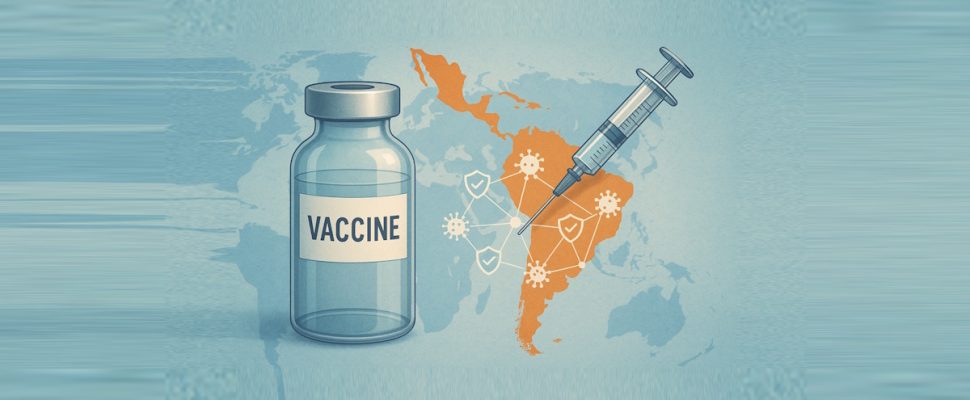

Vaccination remains the most powerful public health intervention ever devised, preventing an estimated 4.4 million deaths each year, according to the WHO. Yet with misinformation spreading faster than science, and routine immunisation disrupted by pandemic aftershocks, even long-protected regions are witnessing a resurgence in preventable diseases. In Latin America, where over 11.7 million dengue cases were reported in 2024 and measles has re-emerged after elimination, the stakes could not be higher.
A Global Example
And yet, even amid global vaccine fatigue, Latin America stands out. This is a region where trust in science endures, immunisation systems are resilient, and new partnerships are reshaping local manufacturing.
“From regulators to public health officials and even public sentiment, we observe significantly less vaccine hesitancy here than in developed markets,” exclaims Sinan Atlig, president of global vaccine giant Pfizer’s LatAm Cluster and chief commercial officer for emerging markets.
“Latin America maintains a robust legacy of immunisation programmes with stakeholders throughout the region recognising the long-term benefits of immunisation,” adds Sarah Aiosa, SVP and president for Latin America at MSD.
And vaccination rates are on the up. Immunisation coverage in the Americas region covered by the Pan American Health Organization (PAHO) (the World Health Organization’s Americas arm, which also includes the US, Canada, and the Caribbean) improved for several key antigens in 2024.
These include Measles, Mumps & Rubella (MMR), pneumococcal conjugate vaccines (PCV3), and Hepatitis B at birth. For the HPV vaccine, the Americas has the highest coverage globally, with 76 percent of girls under 15 years of age receiving at least one dose.
“The openness toward vaccination and the robust vaccine ecosystem – including PAHO’s highly functional procurement mechanisms and countries’ expeditious inclusion of vaccines in immunisation schedules – serves as an exemplar for the rest of the world,” says Atlig.
His company hit the headlines in 2021 with the phenomenal success of its BioNTech-partnered mRNA COVID-19 vaccine, but also markets pneumococcal, meningococcal, and RSV vaccines for both infants and adults.
Despite a broad global portfolio, Atlig proclaims that for Pfizer in Latin America, “vaccines have been, are, and will remain our primary focus.” For instance, Argentina served as one of four countries where Pfizer tested its COVID-19 vaccine, while the firm is now also utilising Argentina for clinical trials of its RSV vaccine.
The situation is not, however, totally rosy, with PAHO’s reporting cautioning that over 1.4 million children in the Americas missed routine vaccines in 2024, with the number of zero-dose children in the region rising by 186,000 to 1,465,000.
Access Innovation
A massive part of what makes Latin America such a hotspot for vaccination are PAHO’s revolving funds. These pooled procurement mechanisms enable countries in the region – most of which are middle- and low-income – to purchase vaccines, medicines, and other health technologies at competitive prices.
The revolving funds are a win-win-win setup for companies, countries, and citizens. For vaccine sponsors looking to enter the region, they create economies of scale, grant multi-year contract stability that supports production planning and investment decisions, and reduce regulatory barriers for vaccine sponsors looking to enter the region.
As PAHO Director Jarbas Barbosa lays out, “our regional platform eliminates the traditional country-by-country regulatory approval process, which can require months of preparation and millions in regulatory costs for each jurisdiction.”
Barbosa continues, “When vaccines are offered through our revolving fund, they receive automatic acceptance across all participating countries, significantly reducing time-to-market and regulatory burden.”
In a region where healthcare expenditure as a percentage of GDP remains below the six percent threshold recommended by the OECD in many countries, these types of initiatives are vital to ensuring continued industry investment and ultimately access to healthcare.
“Our approach aligns perfectly with that of PAHO,” says Aiosa of MSD, whose HPV vaccine was included in PAHO’s revolving fund for the first time earlier this year. “We focus on strategic partnerships with governments, multilateral organisations, and civil society to construct frameworks that broaden access equitably and cost-effectively,” she adds. Another key global player in the field, MSD’s vaccines are currently included in 52 national immunisation programmes across LatAm.
Also on the access front, LatAm’s regulators are getting their act together. In a region that lacks an equivalent of the European Medicines Agency and where differences in regulatory processes can slow or even prevent access to new medicines and vaccines, collaborative efforts and knowledge-sharing are crucial
The region’s leading regulators, aligned under the Regional National Regulatory Reference Authorities (NRAr) banner (ANMAT of Argentina, ANVISA of Brazil, COFEPRIS of Mexico, INVIMA of Colombia, CECMED of Cuba, ISP of Chile, the US FDA, and Health Canada), is advancing towards WHO Listed Authority (WLA) alignment. This will allow greater flexibility in accepting regulatory decisions made in other countries and theoretically speed up patient access. ANVISA and Health Canada already hold WLA status and COFEPRIS is progressing towards it.
Manufacturing Rejuvenation
Access frameworks are all well and good, but to truly meet the immunisation needs of the continent, producing vaccines within Latin America is also vital. The pandemic experience – when the global north stockpiled and prevaricated about sharing new vaccines with other countries – was illustrative, and has led to a rejuvenation of local manufacturing and technology transfer efforts across the region.
“Our response (to the pandemic) has been to establish a comprehensive regional production capacity strengthening programme,” outlines PAHO’s Barbosa.
“This encompasses regulatory framework enhancement, support for existing manufacturing capabilities, and strategic investments in innovative production platforms. We are currently supporting mRNA vaccine development and production projects in both Brazil and Argentina, platforms that provide flexibility for multiple disease applications beyond COVID-19.”
“The COVID-19 pandemic exposed how vulnerable global supply chains can be when every country depends on the same few producers,” adds Francisco Rossi, director of Colombia’s drug regulator INVIMA.
“Our government is supporting both public and private projects through the Ministry of Science and Technology – particularly in vaccine production and the manufacturing of medicines deemed essential to public health. This is not only about self-sufficiency but also about strengthening resilience in future emergencies.”
Meanwhile, leading local companies in the region’s manufacturing hubs, such as Bio-Manguinhos/Fiocruz (Brazil) and Sinergium Biotech (Argentina), have joined the WHO’s global mRNA technology transfer network. Fiocruz reports very large domestic vaccine output, with hundreds of millions of doses produced in recent years, and is expanding capacity. Brazil also doubled yellow-fever vaccine production in 2024.
Most recently, this local manufacturing investment wave led to a tech transfer agreement between Argentina’s government, Pfizer, and Sinergium for a next-generation pneumococcal vaccine.
Pfizer’s Atlig outlines the wide scope of the deal and its potential impact beyond Argentina’s borders thusly. “The innovative element in this agreement is that whilst it will supply Argentina’s requirements – our original agreement’s scope – we subsequently signed a second agreement to supply not only Argentina but all Latin America.”
“This represented the first regional manufacturing and supply agreement of its kind, providing access to our innovative 20-valent pneumococcal vaccine approximately two years earlier than otherwise possible.”
Atlig adds, “This demonstrates that when we align as diverse ecosystem players: multinational pharmaceutical companies, local partners, local governments, and supranational bodies such as PAHO, we can genuinely accelerate vaccine access.”
Aiosa of MSD, which boasts a long-established partnership with Instituto Butantan in Brazil, agrees on the benefits of an ecosystem approach.
“We have engaged in technology transfers for multiple vaccines serving the Brazilian population and collaborate on future vaccine development, including dengue research through clinical trials,” she notes.
“These partnerships demonstrate how we can support governments in allocating resources effectively and equitably, whilst leveraging our industry expertise as a trusted, long-term partner.”
A Bright Future?
Looking forward, Latin America looks set to continue bolstering its vaccine manufacturing, distribution, and education efforts to fight off the looming double threat of communicable diseases and vaccine hesitancy. While the region is not immune to scepticism, Pfizer’s Atlig proclaims that “I remain inherently optimistic; science will prevail.”
For MSD’s Aiosa, information sharing and education will play a major role. “Media channels represent powerful platforms that we should leverage more strategically to disseminate factual, evidence-based information regarding vaccines,” she opines.
PAHO’s Barbosa takes a broader view. Vaccine hesitancy is an issue in the Americas – PAHO also covers the US after all – but just one of many that is preventing more people in the region from accessing vaccination.
“Our approach emphasises three strategic pillars,” he explains. “First, we are enhancing communication between national health authorities and scientific institutions to translate complex immunological concepts into accessible information that addresses specific concerns that the families have.”
“Second, we have developed comprehensive training programmes available through our Virtual Campus of Public Health. The Virtual Campus which has reached over four million healthcare workers across the region, offers more than 150 courses on various public health subjects in English, Spanish, Portuguese, and French.”
“Third, we are addressing structural barriers that impede vaccine access despite positive attitudes toward immunisation. The informal economy encompasses 50 percent of Latin America’s workforce, meaning that accessing vaccination services during traditional hours represents direct income loss for families who cannot afford such sacrifices.
“Additionally, 50 percent of the poorest families depend on single female caregivers who face particularly acute challenges in navigating multiple healthcare visits.”