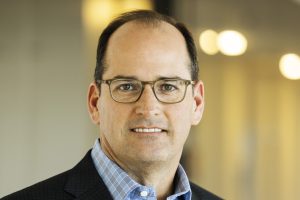
Thomas Gibbs, EVP and President of Lundbeck US, details his three-decade industry journey before taking the reins of the enterprise’s most strategic market. Accounting for over half of global revenues, the US is a key contributor to Lundbeck’s patient impact and scientific delivery. Along with outlining the organisation’s Focused Innovator strategy, he gives his insights into the pricing and affordability considerations of the US pharma market and shares how policy should aim to balance the impact of intermediaries and international price discrepancies. Finally, Gibbs ends with sharing how Lundbeck will continue its dedicated neuroscience focus to advance brain health and transform lives, one patient at a time.
Could you start by sharing a brief overview of the career journey that ultimately led you to Lundbeck?
I have been in the industry for about 30 years, and I like to joke that I started way back when SmithKline Beecham still existed, before it became GlaxoSmithKline.
I tend to think of my career in two chapters. The first 15 years were about building deep and broad commercial experience, including sales, sales leadership, commercial analytics and most extensively in marketing. I worked on several major brands, including as a Product Manager on the antidepressant Paxil at SmithKline Beecham, Product Director on Risperdal in antipsychotics at J&J, and as Vice President of Sales for the vaccines portfolio at Novartis. During that time, I also went back to get my MBA from Wharton.
The second chapter has been focused on building, leading, and transforming businesses. I spent six years at Bristol Myers Squibb, first as the global head for the hepatitis C franchise, overseeing a development portfolio of five products and working across the full lifecycle from discovery through commercialisation. I later moved to the US HIV business, leading sales, marketing, payer strategy, and policy. My last role at BMS was working directly with the COO and the Commercial executive team to redesign BMS’s global commercial model and redefine the global commercial footprint.
From there, I joined Takeda to run the US General Medicine business, leading an organisation of roughly 2,000 people across 12 products and a USD 2 billion portfolio. I then shifted to a completely different environment as the Chief Commercial Officer and employee number 11 at a privately held respiratory-focused biopharma. We took a drug–device combination through Phase III, secured first-pass FDA approval, which is uncommon for these products, and ultimately brought the company through a successful IPO. I later became Chief Commercial Officer at Sunovion, overseeing the US, Europe, and Canada.
Now, almost three years into my role at Lundbeck, I could not be happier. I have worked across small, medium, and large companies, and I do not think one model is inherently better than another. What matters most is having products, pipelines, technologies or platforms that are truly differentiated and address real unmet needs, and pairing that with strong people, leadership, and culture.
For many European mid-cap and speciality pharma companies, the US is a critical growth market. How would you describe Lundbeck’s US affiliate and the role it plays within the global organisation?
As a US organisation, I think it is important that we always remember we are part of a larger global enterprise. That said, the US plays an outsized role for Lundbeck. Looking at our third-quarter results, the US accounts for about 55% of total revenue. While the US is one market among roughly 23 countries where Lundbeck operates directly and 27 partnered markets, the US is by far the largest.
What is equally important is our growth trajectory. Over the past three years, the US business grew six percent in 2022, 11% in 2023, and 16% in 2024. Looking at our most recent nine-month reporting for 2025, the US grew 22% over the same period in 2024. Therefore, the US is not only Lundbeck’s biggest market, but it is also the fastest-growing part of the organisation.
How is Lundbeck’s therapeutic strategy in neuroscience reflected in the US context?
It is interesting to look at Lundbeck’s US evolution through the lens of our neuroscience strategy. Our US journey really began in 2009 with the acquisition of Ovation Pharmaceuticals, which gave us a foundation in rare diseases with a particular focus in rare epilepsies and movement disorders. In many ways, we are now coming full circle as our three therapeutic focus areas of neuropsychiatry, neuro-specialty, and neuro-rare continue to evolve.
Today in the US, we have treatments across migraine, depression, bipolar I disorder, agitation associated with dementia due to Alzheimer’s disease, schizophrenia, and other neurological conditions. Our current business mix is still roughly 70 percent psychiatry and 30 percent neuro-specialty. However, with the acquisition of Longboard Pharmaceuticals in 2024 and the evolution of our pipeline, we will be expanding meaningfully in neuro-rare. This shift is bringing us back to the roots of our US business and positions us to build a more balanced and future-ready neuroscience portfolio.
Following the Longboard acquisition and with several mid- to late-stage assets advancing in the pipeline, where do you see the next phase of Lundbeck’s growth in the US coming from?
As I mentioned earlier, everything starts with having a portfolio of meaningfully differentiated products that address significant unmet needs. When I look at our current US business, our two largest growth drivers continue to give us real momentum.
Rexulti has been our historical growth engine, and we have been able to continuously accelerate its performance. In the first nine months of 2024, Rexulti grew 14%, and in the first nine months of 2025, the brand grew 26%. This performance has also been without any events like new indications or major new data readouts. Going forward, our focus will be to continue maximising Rexulti through loss of exclusivity, in both major depressive disorder and agitation associated with dementia due to Alzheimer’s disease.
On the neuro-speciality side, Vyepti has become one of Lundbeck’s most important global products and is unquestionably the biggest growth driver in the US. In the first nine months of this year, US sales of Vyepti grew by 56%, following 63% growth in 2024 and 66% in 2023. We are also seeing Vyepti used earlier in the treatment paradigm, which reinforces both the value it brings to patients and the runway ahead.
While we continue to perform strongly with our marketed products, we are also proactively transforming our capabilities to support the potential commercialisation of our pipeline assets. I’m especially excited about bexicaserin, a novel investigational treatment for rare epilepsies. We expect that bexicaserin could become the first therapy approved for the broad developmental and epileptic encephalopathies (DEE) category. Equally exciting is amlenetug, which may become the first product ever approved for multiple system atrophy.
Of course, pipeline assets always carry risk, but these two programs represent meaningful opportunities for Lundbeck to lead in areas of significant unmet need and define the next phase of our US growth. At the end of the day, what excites me most is the privilege of bringing truly life-changing medicines to patients.
As a first-launch market, how does the US contribute to strengthening Lundbeck’s position as a global leader in neuroscience, especially from an innovation and access perspective?
It really starts with the policy environment in the US, which is built to support innovation and enable broad access to new medicines. When you look at the global landscape, the US consistently provides the fastest and widest access to innovative therapies. Patients in the US are able to receive new medications much more quickly compared to other regions.
For perspective, Europe only has access to about half of the innovative medicines available in the US. In Asia, that figure drops to roughly one-third. That gap is largely driven by differences in policy frameworks, which reflect how each market encourages innovation, supports investment, and facilitates timely access for patients.
From my perspective, our first responsibility as a pharmaceutical company is to patients and to society. Bringing innovative neuroscience treatments to the market not only changes lives but also helps address broader healthcare costs across a system where pharmaceuticals account for only a small fraction of total spending. Therefore, when you think about Lundbeck’s global positioning, the US plays a critical role in showcasing the importance of our work. The US is where innovation is adopted earliest, where access to new therapies is broadest, and where our ability to demonstrate patient impact can ultimately strengthen our leadership in neuroscience worldwide.
Cost containment has become a major focus in the US, with policies like the IRA and MFN poised to reshape traditional pricing dynamics. From your perspective, what concerns does the industry have about the impact of these policies on sustainable innovation and patient access?
When we talk about cost containment and drug pricing in the US, the conversation often focuses exclusively on branded medicines. However, it is important to remember that 93% of all prescriptions filled in the US are generics, versus seven percent being branded products. Additionally, the reason we have such a strong and affordable generic market is that innovative branded therapies eventually become generics. That context sometimes gets lost in the broader public debate.
There was a University of Chicago study published in June 2025 that I believe adds a helpful perspective.1 Instead of looking only at branded drugs, it examined total pharmaceutical utilisation across Medicare and Medicaid and compared the US to five peer countries: the UK, France, Germany, Japan, and Canada. The study found that US prices were 18% lower than the reference basket on a per capita basis. That is not a statistic most people associate with the US market, but it’s an important piece of the picture.
When we do look at the seven percent volume of products that are branded, lawmakers on both sides of the aisle generally understand how critical biopharmaceutical innovation is, not just for patients and society, but for the US economy. At the same time, the structure of the US market is very different from other countries. Ours is the only system where roughly half of the value is captured by intermediaries rather than by the innovators. Insurers and PBMs collect billions in rebates while often still charging patients based on list prices.
If the goal is to meaningfully lower patient costs, the first step is fixing the rebate system. Rebates should flow to patients at the pharmacy counter. PBMs, who play an important role in the ecosystem, should operate on a flat-fee model rather than being financially incentivised by higher list prices. Without addressing these structural issues, price-setting policies like the IRA will not reduce the actual costs to patients.
With that said, I do think there is room for a more balanced global contribution to biopharma innovation. Today, the US shoulders a disproportionate share of R&D investment.
Ultimately, the concern isn’t about resisting change; it’s about ensuring that policy decisions best serve patients and do not unintentionally weaken the incentives that make breakthroughs possible.
From a scientific perspective, what role does the US organisation play in scouting for new partnerships, collaborations, and potential M&A opportunities for the broader Lundbeck group?
We see tremendous value in having a strong presence close to where so much biopharmaceutical innovation is happening, and the US remains the center of gravity for that innovation. Across our three focus areas of neuropsychiatry, neuro-speciality, and neuro-rare, we are excited about the transformation happening within our own pipeline under the leadership of Johan Luthman, who is Executive Vice President and Head of R&D. Some of that progress is coming directly from our discovery labs, and some is sourced externally. In both cases, we are looking for breakthrough science that addresses meaningful unmet needs.
Within our Focused Innovator strategy, programmatic business development is a core pillar. It sits alongside driving sustainable growth and allocating capital effectively, and it is one of the key ways we bring innovation into Lundbeck, either to develop internally or ultimately commercialise. The US organisation plays an important part in that effort simply because so much cutting-edge neuroscience work is happening here.
A good example is the Longboard acquisition. At USD 2.6 billion, it was the largest acquisition in Lundbeck’s history. It also brought us bexicaserin, which is one of the cornerstones of our late-stage pipeline and a potential best-in-class therapy in rare epilepsies. That is exactly the type of opportunity we aim to identify early, evaluate rigorously, and bring into the portfolio to strengthen our leadership in neuroscience.
How do you engage with patients, caregivers, advocacy groups, and the wider community in the US to establish Lundbeck as a committed and trusted neuroscience partner?
Everything starts with our purpose of existing for patients. One of the stories we often share inside Lundbeck US is the old starfish parable of the child walking along the beach who committed to saving one starfish at a time, believing each one matters. We live by the same belief: every action matters and every person reached makes a difference. Whether we are working in large therapeutic areas like major depressive disorder or agitation associated with dementia due to Alzheimer’s disease, or in rare diseases like multiple system atrophy, where there are only an estimated 16,000 diagnosed patients in the US, that core mission stays the same.
In rare diseases, connecting to patients, caregivers, and advocacy groups becomes even more personal and important as you see firsthand how profoundly these conditions affect not only the individual but the entire family. I recently spent an afternoon with a caregiver and her son living with a rare epilepsy, and it was one of the most meaningful moments of my career. Truly understanding what their day-to-day looks like, and how even small improvements can change their lives, brings a deep sense of purpose to the work we do.
A close connection to the community is what keeps us grounded. It reinforces why we push so hard to bring innovation forward, why we listen closely to advocacy groups, and why we strive to be a trusted, committed neuroscience partner. That connection is our motivation, and it guides how we show up for patients every day.
Looking ahead, what are your key priorities and milestones for Lundbeck US over the next several years?
First, we need to continue driving strong, sustained growth from our current portfolio. That means focusing our resources on our two biggest growth engines, Rexulti and Vyepti, and making sure we’re maximising their impact for patients.
Second, we will continue building the next evolution of our capabilities as an organisation. We already have a strong neuro-specialty model, and now we’re expanding that foundation to establish a true neuro-rare capability. That’s essential as we prepare to bring potential first-in-class medicines like bexicaserin and amlenetug to patients, along with additional pipeline assets that will follow.
The third priority is embracing the technological transformation that’s reshaping how all of us work. I want Lundbeck US to become a bionic organisation where human expertise and AI-driven tools work seamlessly together. Whether it’s improving engagement, strengthening decision-making, or elevating how we support patients, this integration is going to be critical for our next chapter.
It’s a great privilege for me to help lead Lundbeck US into this next phase. We’re building on a strong legacy, but we’re also pushing forward in a way that positions us to be the best in the world at bringing life-changing neuroscience innovations to patients.
Lundbeck’s Danish roots come with a distinct culture that differs from the traditional US corporate environment. As a seasoned executive, how do you balance these dynamics, and what personal leadership philosophy guides your approach?
I really value the culture that comes from our headquarters in Copenhagen. There’s a genuine commitment to patients, to healthcare, and to society that runs through the entire organisation. For me, the goal isn’t to choose between an American style and a Danish style, but to take the best of both. We have a unique advantage of leveraging the strengths of the US market while embracing the purpose-driven, human-centred culture that defines Lundbeck globally.
From a leadership standpoint, the most important thing is to be authentic. Whether I’m sitting at the executive table in Copenhagen or leading our 1,000-person team here in the US, I bring the same approach. I get energy from people, and I like to lead from the front. I’ll never ask someone to walk through a wall for me, but rather have them follow me through it. That starts with building trust by being consistent, being honest, and doing exactly what you say you’re going to do.
I also want to inspire people to genuinely believe in the mission and giving them the confidence that we can succeed. When people feel connected to a shared purpose, you unlock something powerful. Teams become more aligned, more resilient, and capable of extraordinary things. In that sense, psychological safety is also essential. I want people to speak up, challenge ideas, and share their perspectives, knowing their voice will be valued. That diversity of thought helps us see around corners and make better decisions.
Finally, I’ve always believed that to be great at what you do, you need to deeply believe in your purpose, love where you work, and love the people you work with. At Lundbeck US, we strive to create a place where people feel inspired, connected, and excited to show up every day.
With your broad industry experience, you understand how competitive the US talent market is. How do you attract top talent to Lundbeck US, particularly as a mid-cap company competing against much larger players?
The question isn’t whether bigger or smaller companies attract better talent, but it really starts with being crystal clear about who we are. At Lundbeck, that begins with science. We’re a science-led organization, and people see that we’re genuinely driving innovation. Whether that’s creating something entirely new or elevating the standard of what already exists, this approach is what immediately sets us apart.
From there, it comes down to people, leadership, and culture. We need incredibly talented individuals who feel genuinely connected to the work and people who find meaning in what we’re trying to achieve. At the same time, we have to create a culture where people feel a sense of belonging and love coming to work every day. When you combine scientific innovation with great people, and then use culture as your superpower, that’s when you create something special. I’d say it’s almost like capturing lightning in a bottle.
If you ask employees what makes Lundbeck different, or look at the many third-party recognitions we’ve earned, you’ll see that reputation reflected. Our reputation helps us attract some of the best and brightest talent in the industry, even as a mid-cap company competing in a very crowded labour market.
Finally, what message would you like to leave with the healthcare and life science community about Lundbeck’s mission and direction in the US?
Lundbeck is unique because over the past 70 years, we have been exclusively dedicated to brain health. It’s thanks to this singular focus that we’ve built our legacy in neuroscience, been able to have such a meaningful impact on patients, and continue to see significant breakthroughs in innovation.
We can’t forget that neurology is the number one leading cause of disability in the world and the second leading cause of death. There is still a significant unmet need that exists, and our commitment to delivering breakthrough science is entering into a new phase with our growing expansion in the neuro-rare space. Within this context of being a focused innovator in neuroscience, we’re making a deliberate, long-term commitment to serving patients with these brain conditions and the broader society.
From my perspective, Lundbeck US is building a future of close partnership with patients, families, and communities. Partnership is rooted in who we are and what we stand for as we transform lives one patient at a time.
- https://ecchc.economics.uchicago.edu/project/policy-brief-international-price-differences-for-drug-prescriptions/