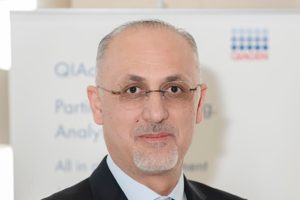
Hussein Abhari, Head of the MENA region, QIAGEN, has led the company’s regional presence since 2017, spanning products for molecular research and clinical testing. His priorities focus on strengthening long-term partnerships, supporting national healthcare strategies, building local scientific capacity and ensuring advanced molecular and genetic technologies translate into real-world clinical impact for patients across the region.
Could you briefly introduce yourself to our international audience and share the main priorities you have focused on since taking on this role?
I have been with QIAGEN since 2017, when we established our physical presence in the region. Over the years, I have worked across molecular diagnostics, life science research, and genomics, taking on different roles as the organisation evolved.
Throughout this journey, my focus – both personally and as a team – has been on strengthening our presence and deepening partnerships in the region, reflecting our long-term commitment. Our priorities have remained very clear. We aim to support national healthcare strategies, which are rapidly evolving, while also building local scientific capacity through education, awareness, and training.
Equally important is ensuring that advances in molecular and genetic testing translate into tangible benefits for patients. Ultimately, it is about moving these technologies from innovation into routine clinical practice, so they can genuinely improve patient outcomes.
Perhaps you could begin by sharing what makes working in rare disease so distinctive, particularly in this region?
The rare disease landscape in our region presents unique challenges and opportunities. We face one of the highest rare disease burdens globally, driven by both genetic factors specific to our populations and the prevalence of consanguineous marriages. Patients struggle significantly to access support, healthcare services, and affordable care. Early diagnosis is absolutely critical, yet we face a persistent shortage of expertise to address regional-specific conditions and limited research focused on our patient populations.
When we examine haemoglobinopathies – sickle cell anaemia and thalassaemia – these conditions are extensively documented in Gulf populations. What European or US universities might classify as rare case studies, we encounter routinely in clinical practice throughout the region.
QIAGEN’s role in the Middle East has evolved substantially. We are no longer perceived merely as a supplier of kits, but rather as a scientific and strategic solution partner working closely with local collaborators and end users. We engage directly with key opinion leaders and stakeholders to address critical issues and deliver meaningful solutions.
We prioritise markets where governments are investing substantially in genomic screening, molecular diagnostics, and data-driven healthcare. We believe we can – and are – delivering genuine impact through early screening and diagnostics. We provide comprehensive solutions spanning the entire workflow: high-quality advanced sample collection and preparation, detection technologies, next-generation sequencing solutions, our novel digital PCR platform, and crucially, QDI bioinformatics – particularly critical in rare disease applications. Early and precise screening or diagnosis is essential, especially in a region where rare diseases are significantly more prevalent.
With increased investment in genomics, precision medicine, and rare diseases, how is the regional landscape changing, and what role can QIAGEN play?
The GCC represents one of the regions with the highest burden of rare genetic diseases globally. Simultaneously, these nations are investing heavily in genomics, screening programmes, and preventive medicine strategies. Substantial budgets and strategic frameworks – such as Saudi Vision 2030 and Oman’s national health initiatives – now position prevention and early diagnosis as fundamental priorities.
This creates a transformative opportunity to shift from late diagnosis to early identification. The economic imperative is clear: late diagnosis costs substantially more than early identification and prevention. We observe strong progress in Saudi Arabia, the UAE, and Qatar, where genomics has transitioned from research activity to integral national health planning.
The transformation in Saudi Arabia exemplifies this evolution. Previously, only specialised centres like KAIMRC and King Faisal Specialist Hospital conducted screening and diagnosis for rare diseases. With Vision 2030, the government now encourages all institutions and organisations to participate actively. Naturally, gaps and challenges remain, which we must address constructively to drive continuous improvement.
The focus extends from research environments to routine implementation, ensuring accessibility for all patients. Priority conditions include haemoglobinopathies – you simply cannot find the volume of sickle cell anaemia or thalassaemia cases in the US that we observe here. Metabolic diseases are equally prevalent. Spinal muscular atrophy represents a significant threat. Genetic neurological diseases, many exceptionally rare, present substantial challenges. A single diagnosis and treatment course can exceed Euro 200,000 per patient. This economic reality explains why governments and policymakers have elevated these conditions to national priority status. Implementation will require time, and challenges persist that we must address systematically.
What ecosystem challenges must stakeholders address to improve diagnosis pathways and patient care?
The primary challenge remains awareness and education. The funding exists, the political will is present, but awareness and education represent major obstacles.
Regulatory frameworks for in vitro diagnostics and research-use-only products currently limit the transition from research to routine clinical practice. We must differentiate clearly between screening and diagnosis – screening applications proceed relatively smoothly, but diagnosis carries consequences for medical intervention, medication, and treatment protocols. Laboratory-developed test regulations, particularly those established by the Saudi FDA, present significant restrictions that impede progress.
Data management capabilities for the vast datasets these technologies generate require substantial development. Legislative frameworks around data and privacy also demand attention – each country maintains its own national standards for patient and healthcare data privacy. These represent the most significant challenges slowing implementation velocity.
Cultural considerations also influence implementation. Premarital testing already exists and is implemented across the region, yet in certain countries, couples who are genetically incompatible will pursue legal action against hospitals to obtain permission to marry. These cases proceed to court, requiring laboratory consultants and directors to provide testimony. This reality creates hesitation among healthcare professionals, who demand absolute precision and certainty before reporting results that could face legal scrutiny. The cultural acceptance of consanguineous marriage within families and communities means couples often fear the consequences of genetic testing. They may live with undiagnosed conditions until complications become severe, only then seeking medical intervention.
How does QIAGEN approach collaboration to ensure meaningful impact, and could you share specific examples?
Without properly identifying stakeholders and conducting appropriate engagement, education, and awareness initiatives, we cannot advance. Building a robust coalition network is essential given the disease burden. These partnerships must be founded on trust and rigorous science, with long-term commitment on all sides. As governments invest in their healthcare systems, we must reciprocate by investing substantively in the communities we serve.
QIAGEN maintains an extensive track record of such collaborations. During the H1N1 pandemic in 2009, we served as the primary supplier supporting the Saudi government. We sustained that partnership for a decade until the threat subsided. Similarly, during Egypt’s hepatitis C virus initiative, QIAGEN played a crucial role in screening, diagnosis, and follow-up monitoring.
In Oman, we began working with key opinion leaders on latent tuberculosis in 2016, commencing full-scale execution in 2024. This demonstrates our commitment to long-term, high-impact partnerships. Our contribution extends beyond providing diagnostic kits – we invest substantially in awareness campaigns, education, and post-implementation support as a continuous process.
Egypt’s latent tuberculosis and dialysis initiatives represent another landmark example. We supported one of the largest pilot studies conducted globally for dialysis patients, screening more than 28,000 individuals, with findings published in leading journals.
During COVID-19 pandemic, the first viral strain was identified at King Abdullah University of Science and Technology using QIAGEN panels at the pandemic’s earliest stages, enabling critical variant identification. We work closely with Saudi Arabia and the Hajj (Pilgrimage) authorities on meningitis surveillance and prevention – a genuinely national-scale initiative. The particular strength of this programme lies in our collaboration with GSK, providing comprehensive solutions from diagnosis through vaccination, patient qualification, follow-up, and treatment. This exemplifies true prevention medicine at the national programme level.
Your portfolio spans diverse therapeutic areas. Could you clarify your footprint and what rare disease represents within your broader offering?
Molecular testing fundamentally begins with DNA – the building blocks of life that are consistent across applications. For sample collection, we provide high-quality solutions for sensitive and delicate specimens. Sample preparation encompasses quality control and genetic material extraction – DNA and RNA. We offer complete solutions.
For detection, we provide comprehensive workflow solutions across multiple technologies: traditional quantitative PCR, next-generation sequencing library preparation and sequencing reagents, and digital PCR with our QIAcuity system that is being used in a range of applications, in particular cell and gene therapy, biopharmaceuticals, inherited diseases and oncology.
Most critically, we lead in bioinformatics through our QDI business known as QIAGEN Digital Insights. We offer extensive databases with AI-driven solutions adaptable to specific customer requirements from research to clinical healthcare.
Our bioinformatics capabilities are continuing to continues evolving – more than 300 scientists continuously feed, update, and refine these databases for utilisation according to institutional and regional requirements. Because we maintain presence in both research and clinical settings, establishing the laboratory foundation enables application across rare diseases, oncology, and precision medicine. With proper foundational infrastructure and settings established, implementing any additional application becomes substantially easier – primarily a matter of training and expanding that scientific capacity whilst transitioning from research to clinical practice.
Looking forward, what developments excite you most? What milestones or projects do you anticipate?
Discussions in the Middle East inevitably reference geopolitical risks. However, we view this as opportunity – there is always room to advance and work closely with our customers.
QIAGEN is investing heavily in education and awareness initiatives. We are fully committed to this region through a strong local presence, an expanding range of scientific partnerships, important education programmes and long-term collaborations. Our ambition – what drives our daily work – is transforming genomic science into genuine advances in science, many of which will have an impact on the lives of patients. We cannot allow these advances to remain confined to research centres. We must transition these advances to routine clinical practice, which cannot occur without sustained engagement with key opinion leaders, stakeholders and policymakers.
We fundamentally believe everyone deserves access to high-quality healthcare. We align ourselves with government initiatives throughout the region on national projects that will deliver meaningful impact, particularly in preventive medicine.
Any final thoughts you would like to share with stakeholders across the region and internationally?
Our vision is helping our customers to make improvement in life possible. We are actively engaged in technology transfer within countries, building sustainable local capacity for the long-term benefits of all throughout the region.