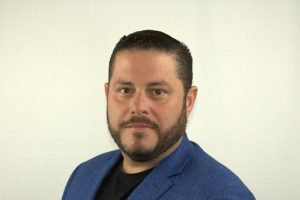
Dr. Eduardo Nicolau shares his journey from being a professor of chemistry to becoming Executive Director of the MSRC in 2021. His leadership focuses on financial stability, creating a biotech incubator, and establishing key partnerships with the industry, including a significant collaboration with the biotechnology company CytoImmune Therapeutics for cancer and autoimmune research. Dr. Nicolau highlights the Center’s expansion plans to position Puerto Rico as a drug development and research hub while also attracting and retaining global talent.
To start, could you introduce yourself and share your journey to becoming the Executive Director of the MSRC?
My name is Eduardo Nicolau. I began my academic career as a professor in the Department of Chemistry at the University of Puerto Rico Rio Piedras campus and as a researcher at the MSRC in 2014. Eight years later I became the Executive Director of the MSRC. The MSRC is a public corporation affiliated with the university that operates independently.
What were the first initiatives you implemented upon your arrival as Director at the Center?
There were quite a few, but one of the most pressing issues we faced was significant financial difficulties. I focused on expense control and sought new funding sources to develop the facility further. Another key initiative was establishing a biotech incubator. While many were discussing the concept then, it had yet to become a reality. We took the lead in by engaging with the private sector, the University and the Government. Start-ups coming to Puerto Rico lacked a space to establish and develop their intellectual property portfolios, so we created that environment within our facilities.
As you mentioned, one of your primary goals is to develop partnerships with the private industry. What strategies are you implementing to attract more alliances with both emerging and established companies in the biotech sector?
We employ several strategies to achieve this. A key partner for us is Invest Puerto Rico, they have considerable expertise in attracting companies to the region. We also collaborate with the Puerto Rico Science Trust and the local Department of Economic Development and Commerce.
Additionally, we participate in key conferences where companies seek partnerships, such as the BIO International Convention. This year, for instance, we attended the event in San Diego. Another important strategy is publicity—we strive to raise awareness of our work and capabilities, ensuring potential partners understand the opportunities available to them here.
Could you elaborate on what is expected from the collaboration with CytoImmune, especially their research on autoimmune diseases and cancer treatment?
One of our current partnerships is with CytoImmune Therapeutics Puerto Rico, a genome cell therapy company. Their expertise lies primarily in process development and manufacturing. They came to us interested in partnering to have the opportunity to conduct research and development. At the same time, we were looking for a partner who could assist us in developing our clean rooms to further develop our process development capabilities. They are not the only company that we are collaborating with, we have established several partnerships.
I understand you currently have over 300 researchers working at the Molecular Center. What plans do you have to continue expanding the Center’s capacity and strengthening the scientific community here in Puerto Rico?
The figure includes students, post-docs, and faculty. When this building was inaugurated in 2010, it only had two floors. Although it appears fully constructed, we have been developing it in phases. We are now set to start construction on the fourth floor, which will be dedicated to incubation and technology transfer, focusing on the development of biologics and vaccines. We recently completed construction on the fifth floor, and we are currently seeking funding for one more floor.
We aim to strengthen our position within the broader Science City initiative, which includes collaboration with the Puerto Rico Science Trust and the main campuses of the University of Puerto Rico, including the Comprehensive Cancer Center of the University of Puerto Rico. We believe our Center plays a vital role in the research and preclinical trials landscape, helping to position Puerto Rico as a hub for drug development and research.
How would you assess Puerto Rico’s current standing in terms of research?
Puerto Rico has been a manufacturing hub for many years, but unfortunately, we are behind compared to other jurisdictions in research and development. The government is cognizant of this and is taking steps to fund institutions like the MSRC and boost the research and development sector. We are aware that other countries and jurisdictions can provide manufacturing work for significantly lower costs. By supporting research and development, Puerto Rico aims to gain a competitive edge over these nearby jurisdictions.
What do you think is currently missing in Puerto Rico’s research landscape?
One of the primary issues that has historically been missing, especially back in 2010, was the regulatory framework. At that time, researchers from the University of Puerto Rico were not allowed to commercialize their inventions. There was a stipulation in the code of ethics preventing them from doing so and that hurt the ecosystem of innovation because researchers did not have an incentive to further develop their research portfolio into possible commercial ventures. Fortunately, this was rectified in 2010, but it is important to note that other jurisdictions resolved similar issues decades ago.
The Bayh-Dole Act, enacted in 1980, allowed for patents and intellectual property generated from government grants to be retained by universities, enabling researchers to start their own companies and facilitate tech transfer. Puerto Rico was quite late in addressing these regulatory aspects.
Additionally, there is a significant need for support in terms of resources—both economic and infrastructural. We welcome many start-ups and companies, and they often express their excitement upon discovering our facilities. There aren’t many research labs or incubators on the island; while there are process development and manufacturing facilities, dedicated research spaces are limited. We do have available space, but it tends to fill up very quickly. So, enhancing infrastructure is another critical area for improvement.
Since Puerto Rico is part of the USA, many talented individuals may be tempted to move to the mainland for better opportunities. How are you working to attract global talent, particularly Puerto Ricans who have relocated to the United States?
That is indeed one of our main challenges. To address this, we are collaborating with the Department of Economic Development and Commerce on a pilot programme aimed at retaining and attracting top-tier talent within the Biosciences. Typically, most talent in Puerto Rico tends to gravitate towards universities across the US when it comes to graduate studies and once there, they typically end up landing jobs on the mainland. What we are doing is offering top-tier researchers the chance to return to Puerto Rico with competitive salaries, start-up funds to develop their research, and dedicated research space. Importantly, these researchers aren’t restricted by university obligations; they are able to focus solely on their research without the teaching and administrative duties that typically come with a faculty position.
Of course, they will need to apply for grants to fund their research, but we are providing them with the opportunity to stay in Puerto Rico. This model has been successfully implemented in other places, but it is new for us.
We currently have two researchers in this pilot programme—one specialising in RNA vaccines and technology, and the other in neuroscience with a focus on behavioural models that utilise AI without needing to work directly with animals. In terms of return on investment, as long as the grants are approved, both have already secured enough research funding to cover the costs of bringing them back.
We have learned along the way about strengthening their administrative capabilities, and overall, it is working very well. We hope to expand this programme further, potentially with the support of the local Economic Development Administration, which has funds for workforce development.
Additionally, one of the ways we make our facilities more attractive is by ensuring our laboratories and instrumentation are state-of-the-art. They can compete with any top facilities worldwide, making it an enticing option for talented researchers.
What are the key research disciplines that the Center focuses on to build a knowledge-based economy?
We have identified four main research areas. First is neuroscience, particularly neuroplasticity and related topics. The second area focuses on chemical discovery and natural products, primarily involving organic chemists. Third, we are heavily involved in materials and biomaterials for biomedical applications. Lastly, cancer research has become increasingly prominent in our work. We are actively looking to support semiconductors and “chips” research aided by artificial intelligence… that is to come!
How is Puerto Rico progressing in terms of collaboration between industry, government, universities, and academia to foster strong science and a healthier nation?
It wasn’t until recently that the government began to see this Center as an important strategic partner. However, with the current Secretary of Economic Development and Commerce, expressing interest in our work, we received the support we needed to get things started. Their involvement, both in terms of attention and economic support, has been crucial.
The government needs to be involved, as well as the industry—especially in the research domain, not just manufacturing. We need governmental assistance to attract these companies and incentivize them to focus not only on manufacturing but also on research initiatives.
Given the recent developments and how the Center was previously perceived, what do you think will happen as elections approach? Will the situation remain the same, or do you have a different perspective?
We have been proactive in raising our public profile and making sure that public servants understand the significance of our work. People now appreciate what this Center stands for.
We have made a concerted effort to get the word out, and I genuinely think we are at a point where the government recognizes the need to support manufacturing but also innovation.
I think the government has realized that it is essential to have a strategy to pivot strategically towards innovation. By not doing so we may risk losing manufacturing companies to other jurisdictions. Other jurisdictions could attract a significant portion of the manufacturing sector currently in Puerto Rico. If we don’t act decisively now, we could face serious challenges in terms of economic development.
What is your vision for the MSRC in the next five years?
In the short term, we aim to complete the construction projects we have underway. Long term, I envision a growing ecosystem that places significant importance on research and development in the biological and molecular sciences. Ideally, we hope to expand our facilities and have another building like this one soon.
To wrap up, how would you pitch the MSRC to our global readers?
The MSRC is truly a special place in Puerto Rico, it is a beacon of hope for young generations interested in research. It offers an opportunity to engage in groundbreaking work, generate new intellectual property, and ultimately contribute to the economy of Puerto Rico.
I see this Center as the epicentre of research activity in Puerto Rico—a space where academics, students, technicians, and support staff come together with a common goal. With our industry partners, academia, and government support, it is also an ideal environment for start-up companies and small enterprises to develop their research portfolios.
One unique aspect of our Center is the ability to move from basic research to preclinical work under one roof. The Center offers a soft-landing spot for companies looking to advance their projects.