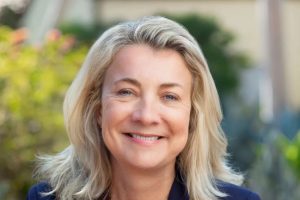
Catherine Owen Adams, CEO of Acadia Pharmaceuticals, discusses how the company’s dual commercial pillars in Parkinson’s disease psychosis and Rett syndrome are delivering much-needed impact for patients with significant unmet needs and shaping Acadia’s next phase of growth. She shares insights into the company’s expansion plans, pipeline strategy, partnership goals, and the leadership culture she has been building since joining Acadia. Adams also reflects on her transition from senior leadership roles at Bristol Myers Squibb and Johnson & Johnson to leading a growing biotech on an internationalization journey.
After more than three decades in senior executive roles at Bristol Myers Squibb and Johnson & Johnson, what motivated your transition from large pharma to biotech, and what about Acadia resonated with you at this stage of your career?
I spent around 30 years in large pharma with 25 years at Johnson & Johnson and five at Bristol Myers Squibb. During that time, I worked across 13 or 14 different therapy areas and built my career through the commercial organization, starting in the UK and eventually moving to the US. For much of that journey, it did not really feel like big pharma. At least at the time, Janssen operated very much as its own entity and was relatively small, so the experience still felt entrepreneurial to some extent. That said, large pharma offers incredible opportunities. You gain broad experience, strong training, and the chance to lead large, complex businesses.
My final years at Bristol were intense but extremely rewarding. I ran the international business, then the US business for two years, took the company through the Celgene merger, and helped launch nine products in five years. At the end of that period, I felt I had reached a natural inflection point and started asking myself what the next horizon might be.
Around that time, I had also joined the boards of a few biotech companies and spent about five years watching those organizations grow and evolve. I really enjoyed that environment and the opportunity to contribute from a large pharma perspective. Over time, I became convinced that I would enjoy leading a biotech myself. But I knew that finding the right fit mattered. A very early-stage, preclinical company was probably not the right match for my skill set. I was looking for a commercial-stage organization that was still small enough to shape, but substantial enough to have real impact.
Acadia turned out to be a Goldilocks opportunity. It had two commercial products, a strong and growing pipeline, and was just beginning to expand beyond the US. My experience aligned well with where the company needed to go next. On a personal level, the therapy areas were also deeply motivating for me. I am a caregiver to two parents, one with Alzheimer’s disease and one with Lewy body disease, and psychosis has been a very real part of my life over the past several years. That connection made Acadia’s work in Parkinson’s disease psychosis particularly meaningful to me.
I also developed a strong passion for rare diseases during my time at Bristol where I helped launch into a couple of rare disease areas. What stood out to me was not only how different the rare disease space can be, but also how powerful the patient and advocacy communities are, and how significant the unmet need remains. Bringing together CNS and rare disease in one company felt like a compelling and exciting opportunity.
The timing worked out well, and I feel very fortunate. I am about 15 months into the role now, and I am still genuinely excited every day to come in and do the work.
When you stepped into the CEO role, where did you find Acadia in its journey? As we move into 2026, which achievements or areas of progress over the past year stand out most to you?
When I joined Acadia, DAYBUE, our therapy for Rett syndrome, had been on the market for just over a year. It had launched strongly, but then went through a couple of fairly rocky quarters. The analyst community was starting to question what was happening and whether the trajectory was going to continue downward. One of the reasons the board brought me in was to take a fresh look at the situation and help stabilize and reset the business through my commercial background.
At the same time, Nuplazid was growing at a steady rate, but it had not really been re-examined for quite some time. When I came in, I brought a fresh perspective and fairly quickly made the decision to change out parts of the C-suite. I brought in a new Chief Commercial Officer and spent much of last year focused on getting the commercial organization back on track.
For DAYBUE, that meant expanding the field force, sharpening the strategy, and really reassessing how we were approaching the market. We shifted focus from primarily centers of excellence into the broader community setting, revisited our targeting and messaging, and strengthened our patient support efforts to better help families through the transition onto therapy. We went back to the basics, but in a very deliberate way.
With Nuplazid, not much new work had been done on the brand for a long time. Both Tom Garner, our new CCO, and I felt it needed a fresh look. When I arrived, a direct-to-consumer campaign featuring Ryan Reynolds had just launched, focused on raising awareness of hallucinations and delusions associated with Parkinson’s disease. That campaign was gaining real momentum and we saw an opportunity to reinvest in the brand more broadly. Therefore, we made the decision to increase our investment in Nuplazid because we believe there is still significant unmet need in the US. There is a lot of off-label use of antipsychotics in this population that is not appropriate, and we think Nuplazid can play a much bigger role. We are now doubling down and are very excited about putting the brand onto a new growth trajectory.
Another major area of progress has been the global expansion of DAYBUE. We established a European organization, recruited key talent, and moved quickly to understand the European market. We also launched three named patient access programs in Europe, Latin America, and Israel so that patients outside the US could access DAYBUE as soon as possible. That has been a meaningful achievement for the team.
Overall, 2025 has been a very commercially focused year, about recalibrating the business and getting it back on track for where we want to take it next. Now, as we look ahead, we are anticipating a Committee for Medicinal Products for Human Use (CHMP) opinion for DAYBUE in Europe in the first quarter of 2026, which will be an important milestone as we move into the next phase of Acadia’s journey.
Acadia currently has two commercial products focused on Parkinson’s disease psychosis and Rett syndrome. Could you introduce the company’s therapies and describe the impact they have had on patients and their families starting with Parkinson’s disease psychosis.
Nuplazid was our first product to launch. It is the first and only approved treatment specifically for hallucinations and delusions associated with Parkinson’s disease psychosis. Most people think of Parkinson’s primarily as a movement disorder, but what is less widely understood is that around 50 percent of patients will experience some form of psychosis over the course of the disease. That psychosis can take the form of hallucinations or delusions.
Hallucinations are seeing things that are not there, while delusions are believing things that are not true. These symptoms can be very distressing and extremely difficult for families to manage. I can speak to this from personal experience. When a parent starts to believe that people are stealing from them, plotting against them, or that friends and family cannot be trusted, it often starts subtly. It does not immediately feel extreme or alarming. But over time, especially when hallucinations begin, it becomes clear that something is very wrong. That moment when families realize things are not okay can be incredibly difficult.
This is why raising awareness among caregivers has been such an important focus for us over the past few years, and why it is so critical to highlight that there is an approved therapy available. Patients with Parkinson’s disease psychosis are often treated with off-label antipsychotics which can come with significant drawbacks including strong sedative effects. In many cases, patients are given high doses that may reduce hallucinations or delusions, but at the cost of leaving them heavily disengaged from daily life.
Nuplazid offers a very different experience. We see strong clinical results in reducing hallucinations and delusions, and it has a clean safety profile without sedation. That makes a meaningful difference not just for patients, but for their families as well. It allows people to remain present and engaged, rather than feeling like they are being managed through sedation.
We continue to invest heavily in awareness because there is still a large unmet need. While it is difficult to precisely estimate market share, we believe that only around 20 percent of patients who could benefit from Nuplazid are currently receiving it. That tells us there is significant room for growth and a real opportunity to improve care for many more patients living with Parkinson’s disease psychosis.
Turning to Rett syndrome, what has DAYBUE meant for patients and caregivers?
DAYBUE is the first and only approved treatment for Rett syndrome. Rett syndrome is a severe neurodevelopmental disorder that primarily affects girls. It is genetically driven, but it is not inherited. It is caused by a mutation or deletion in the MECP2 gene which disrupts the way certain proteins are produced in the brain.
What typically happens is that girls develop normally for the first 18 months to two years of life. Then they begin to miss developmental milestones. They may stop babbling or speaking, lose previously acquired motor skills, and gradually regress. Diagnosis itself often takes around six months, which can be an incredibly difficult period for families. Until DAYBUE, there were no approved treatments available. These girls live with a wide range of symptoms, including seizures, gastrointestinal issues, bone and orthopedic challenges, and profound developmental impairment.
DAYBUE has now been on the market for two years, and it represents the first therapy approved specifically for Rett syndrome. It works at the level of synaptic function in the brain. While we do not fully understand every aspect of its mechanism, what we have seen in clinical trials is meaningful improvement over time across several areas. These include communication, hand use, motor function, and other behavioral and developmental measures. Essentially, the therapy appears to improve synaptic connectivity and neuronal plasticity, which supports gains across multiple aspects of development.
Parents caring for daughters with Rett syndrome face extraordinary challenges. These children require round-the-clock care. Many do not sleep well, in addition to needing full-time support during the day. Families are often physically and emotionally exhausted, especially in the period following diagnosis and as their daughters grow older. This is why we have become deeply involved with the Rett community, working closely with families and caregivers who shoulder the responsibility of caring for these remarkable children.
Rare disease is never just about the therapy. It is about partnership. Working with this community has been an incredibly meaningful experience for our team, and we remain deeply committed to the patients as we continue to expand access to DAYBUE globally.
What is Acadia’s vision for future international launches, and what do you see as the most critical success factors for building strong global commercial strategies?
For Nuplazid we do not currently have plans to expand globally. It is at a more mature stage of its lifecycle, and realistically, the window to take that product international has passed. That said, we absolutely see a global future for the assets coming behind it in the pipeline.
For DAYBUE, international expansion is a top priority. A critical part of that strategy is working closely with patient communities as rare disease advocacy looks very different across the world. In the US, you may have two or three major patient organizations. In Europe, there are often multiple groups per country, sometimes operating independently and sometimes under broader umbrellas such as NORD equivalents. That means the landscape is more fragmented, but also very locally rooted. However, there are still international organizations as well. The International Rett Syndrome Foundation (IRSF) is one example with whom we work closely.
Our focus is not just on education, but on listening. We want to understand how needs are evolving and what families expect next. That is especially important as we advance additional Rett programs in our pipeline. We actively involve advocacy groups early, including around patient-reported outcomes in clinical trials, formulation considerations, and how future therapies may fit into daily life.
Beyond approval, patient support also looks very different outside the US. In the US, comprehensive patient support services are well established and permitted. In many European countries, pharmaceutical companies cannot provide the same type of direct patient support. There are also restrictions around branded direct-to-consumer communications. So you have to think very differently about how you support families through education, unbranded resources, and collaboration with local organizations.
From my experience I understand that global commercialization requires flexibility. In many ways, the US is the most permissive market whereas Europe requires a country-by-country approach, with different regulatory, legal, and cultural considerations. Our goal is to adapt our commercial model while focusing on what matters most. This means ensuring families have access to the right information, education, and support so that DAYBUE can be part of daily life for their daughters.
Having articulated a long-term growth strategy centered on neurological disorders and rare diseases, how do you balance focus across these two areas? What development strategies are going to shape Acadia’s future portfolio?
It is fair to say that today we have a strong neuroscience pipeline and a strong rare disease pipeline, but I would like to see it become both stronger and more diverse over time. When I came in as CEO, our Head of R&D, Liz Thompson, had only been in place for about two months. I joined at roughly the same time as her and we have been shaping this together. We also both have an ambition to expand our rare disease pipeline beyond where it is today.
Right now, our focus within rare disease is very much on neurological conditions. Over time, I would like us to broaden that scope into areas such as endocrine, cardiovascular, and potentially immunology. We are also looking closely at modality balance. At the moment, the pipeline is heavily weighted toward small molecules but we would like to bring in more large-molecule innovation over time. Today, we do have one antisense oligonucleotide (ASO) collaboration with Stoke Therapeutics.
That said, pipelines do not appear overnight. For a company of our size, we do not have the same ability to acquire assets as I did in my previous roles at larger organizations like J&J or BMS. So our approach has to be different. We rely heavily on earlier-stage innovation, strong academic collaborations, and partnerships with smaller discovery-focused companies. Our internal research function is relatively small, so much of our research effort comes from external collaboration and development which is a very deliberate strategy for us.
At the same time, we have also strengthened our business development capability. I recently brought in a new Head of Business Development with extensive global experience, and one of my priorities is to look beyond the US for innovation. There is a significant amount of high-quality science happening outside the US, and historically Acadia has been more US-focused than I would like going forward. Having run commercial businesses across more than 20 countries in my previous roles, I am very aware of the innovation coming out of academic centers and smaller biotech companies globally. Since I joined, we have already signed a deal with a company in Sweden and more recently a smaller collaboration in France. My perspective is to look for innovation wherever it exists, rather than limiting ourselves geographically.
What role do partnerships hold for Acadia, and what characteristics make a collaboration attractive for the company?
We see partnerships as absolutely essential, particularly because there are areas of drug development that are being fundamentally accelerated by advances in big data and technology. Those are not capabilities we have in-house, nor should we try to build all of them internally. Instead, we think very deliberately about where partnerships can complement what we already do well.
What we are looking to do is plug into organizations that have deep expertise in areas where we do not, especially around data-driven innovation. That includes using technology and big data to speed up development stages that have traditionally taken a long time. There are now approaches that allow you to evaluate druggable targets and make early decisions much more quickly than before. Processes that used to take years can now happen in weeks.
We are particularly interested in partnerships with academic institutions and companies that are strong in these areas, whether that is data innovation, biomarker development, or more precision-based approaches to drug development. Biomarkers are a good example of where innovation can significantly improve how we design trials, select patients, and ultimately increase the likelihood of success.
So for us, partnerships are very targeted. It is less about broadly collaborating for the sake of it, and more about identifying specific gaps and working with groups that can help us move faster and smarter through development. That is where we see the most value right now.
Acadia’s annual report highlights an incremental pipeline opportunity that could reach up to USD 11 billion in potential value. What priorities are you focusing on to help realize this opportunity?
Data and information are probably the biggest enablers for a company of our size. Small biotech companies can really harness data to leapfrog and compete with much larger players because it allows us to do things faster and with fewer resources than would have been possible in the past. We can also be more nimble. I do not have layers of governance or hundreds of committees slowing decision-making. We can look at the data, make decisions quickly, and move resources to where they will have the most impact.
That is something we are actively building into the foundation of Acadia. With our Chief Information and Data Officer, Scott Cenci, coming in, we are making a real investment over the next couple of years in data, analytics, and technology to support both R&D and commercial. The goal is to bring our data into a much more connected and agile infrastructure so we can see trends earlier, make decisions faster, and act with more confidence.
The second major driver is globalization. Expanding beyond the US is critical to unlocking the full value of our pipeline, and that global footprint will continue to be an important growth lever for us.
Third is precision medicine within our development programs. We are very focused on being biomarker-drive and making sure we are testing the right therapy in the right patient population with the right underlying biology. That allows us to design better trials, make clearer decisions, and improve the chances of success.
Finally, these pillars all come down to people. Talent really matters, and we want Acadia to be a place where people want to come. Whether they are coming from large pharma and looking for something different, or from smaller biotech environments and wanting to take the next step, there is opportunity here to make a big impact. We are strongly cash-flow positive, we have two commercial products, a solid balance sheet, and we are growing quickly. We will be close to 1,000 people by the end of next year with headquarters in the US, a European base, and a new office in San Francisco. We are a big, small company with the ability to operate differently. Our latest engagement survey puts us in the top 25 percent globally according to Gallup, which tells me we are building a place where people feel connected and motivated.
How has your experience at Bristol Myers Squibb and Johnson & Johnson shaped the leadership priorities you are setting at Acadia, and what kind of culture are you aiming to build?
I feel very fortunate to have had the career I have had with such a strong grounding at Johnson & Johnson and Bristol Myers Squibb. These are companies that are deeply rooted in science, patient need, and ethics. They are organizations that have been built over more than 100 years, and they were incredible places to grow as a leader. I learned a great deal from very smart, thoughtful people who gave me opportunities to develop and take on different challenges.
That experience really shaped how I think about leadership. Patient centricity and a strong ethical foundation backed by rigorous financials, strong commercial execution, and constantly assessing performance all matter. The principles of learning to continuously examine how we can do things more efficiently and effectively stay with you.
As you move into the CEO role, though, you also realize that people have to be able to bring their whole selves to work. They need to bring their passion, individuality, and different perspectives. You cannot build a culture that is purely top-down. As a leader, you have to set the tone, but you also have to create space for people to contribute in meaningful ways.
When I came into Acadia, I wanted to bring new energy, ambition, and aspiration. I set a high bar for quality and for what I expect from the business and from our outputs. At the same time, I believe strongly in being open, honest, and treating people like adults. That means communicating clearly, being authentic, and explaining the why behind the what.
I think what I have tried to bring is clarity, a clear vision for the future, and a sense of momentum. There is a lot of energy and positivity around what we are building, but it only works if people collaborate, communicate, and support one another. We are a small company, and in a small company everyone ends up doing more than one job. That requires people who want to show up, lean in, and give their best every day. That is what I am trying to model myself. I try to be present, stay connected across our sites, and be actively involved with our teams.
On a personal level, what has been the most rewarding, surprising, or energizing aspect of transitioning from multinational pharma to biotech?
The honest answer is that it has been more fun than I expected. I really jumped in with both feet, and it has confirmed for me that this was the right opportunity at the right time. I am genuinely having a great time doing it.
At the same time, it is also hard work. As a CEO you are constantly shifting between internal teams, patient advocacy groups and the communities you serve, policymakers and government stakeholders, and then of course the board, investors, and broader shareholders. Each group has different expectations, different needs, and different perspectives. You find yourself changing hats five or six times a day. One moment you are thinking like an investor, the next you are focused on your people, then on patients, then on policy. Making sure that each of those groups feels heard and that you are telling the right story in the right way is a skill you do not fully appreciate until you are actually sitting in the role. But that dynamism is also part of what makes it a lot of fun.
One thing that has really stood out for me is how supportive the board has been. The Acadia board has given me the space to come in, make changes, and do things differently, which I deeply appreciate. We are still early in the journey at just over a year in, but I am really enjoying leading the team through this phase and am happy with my decision to join Acadia.
What final message would you like to share with the global life sciences and healthcare community on behalf of Acadia?
We have evolved Acadia’s mission and vision over the past year, and that is really what keeps us moving forward. At the core, we want to support underserved patients in neurological and rare diseases. That mission guides everything we do and it motivates us as we think about new diseases where we can make a difference, and the new families and patients whose lives we can improve.
For me personally, one of the most satisfying parts of leading a small biotech is the direct connection to the community we serve. Getting to meet the clinicians and physicians who have used our therapies and hearing firsthand how they have changed patients’ lives is incredibly powerful. I truly believe that small biotechs play a critical role in the innovation ecosystem, and that closeness to patients, caregivers, and clinicians allows you to stay grounded in real-world impact. It keeps the work personal and it is what excites me most about continuing this journey with Acadia.