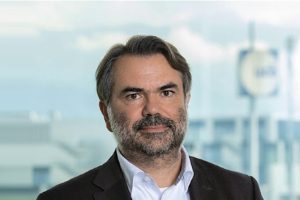

Fabrice Véricel and Geoffrey Folie explore UCB's strategic growth, highlighting its European sites in Braine-l'Alleud, Belgium and Bulle, Switzerland and their roles in global pharmaceutical production. Key topics include the transition to biologics, embracing AI for process optimization, and sustainability initiatives.
How do UCB’s European production sites contribute to global supply, and what sets them apart in terms of focus and future strategy?
Geoffrey Folie (GF): UCB’s European manufacturing network is anchored by two major sites: Braine-l’Alleud in Belgium and Bulle in Switzerland. These facilities form a critical part of UCB’s global operations, producing and distributing pharmaceutical and biological products for markets spanning Europe, the United States, Japan, and other international regions. While both sites engage in pharmaceutical and biological manufacturing, each brings distinct strengths to the table. Bulle focuses on microbial manufacturing, whereas Braine-l’Alleud specializes in mammalian cell production. Additionally, Braine-l’Alleud handles fill-and-finish and packaging operations, which are not present at the Bulle site.
The differentiation between these sites is strategic. Over time, UCB identified the need for dual sourcing of certain products to enhance supply chain security and ensure global availability. This led to the development of complementary capabilities at the two locations. However, for some products, maintaining dual internal manufacturing sites is not economically justified, prompting a targeted approach to optimize production efficiencies. The company continues to refine and define the roles of each site to align with market demands and strategic growth objectives, ensuring responsiveness and operational excellence.
What prompted UCB’s expansion into Switzerland, and how has this journey evolved over the past three decades?
Fabrice Véricel (FV): UCB’s establishment in Switzerland dates back to 1996, driven by several strategic considerations. Chief among them was the pursuit of political and social stability—an essential foundation for long-term manufacturing operations. Switzerland’s stable environment ensured predictable, consistent regulatory frameworks that evolve through collaboration and consensus, creating a secure platform for sustained business growth.
Access to a rich talent pool was another key motivator. Switzerland remains a powerhouse of expertise across pharmaceuticals, biotechnology, research, and manufacturing. Our proximity to institutions such as the École Polytechnique Fédérale de Lausanne (EPFL) allows us to forge strong academic-industry partnerships, tapping into a steady stream of top-tier talent. EPFL and other universities consistently adapt their curricula to align with industry needs, particularly in biotech manufacturing, further strengthening this collaboration. Additionally, regions like Sion and Freiburg contribute significantly by offering specialized training modules in biotech and chemical manufacturing. Today, the emphasis lies firmly on harnessing Switzerland’s exceptional capabilities, skills, and the opportunity for long-term, sustainable growth within a thriving pharmaceutical ecosystem.
How has UCB adapted its capabilities and talent to support its transition from small molecules to biologics, and what has been the impact on your manufacturing sites?
FV: At our Bulle site, UCB has consolidated chemical, pharmaceutical, and biological manufacturing capabilities into a single location, creating a comprehensive framework that supports a wide range of operations and talent development. This integration allows us to adapt seamlessly to industry shifts and align with academic advancements, ensuring we stay at the forefront of pharmaceutical innovation. We benefit from strong collaborations with nearby academic and research institutions in regions like the Swiss Riviera and French-speaking Switzerland, fostering a dynamic talent pipeline tailored to meet evolving industry demands.
Our transition from chemical to biological production has been guided by a phased evolution of capabilities, facilitated by the natural cycle time of molecule development and facility expansion. This deliberate approach provides the flexibility to realign our internal capacities and adopt new competencies as market needs change. At Braine-l’Alleud, for instance, we are advancing from a focus on chemical production to a more robust emphasis on biologics, leveraging this transition period to upgrade our infrastructure and incorporate fresh expertise.
GF: Fabrice rightly emphasizes our commitment to upskilling. UCB’s growth from small molecules to biologics is not solely about attracting external talent but also about fostering the development of our existing workforce. We invest heavily in training programs to help chemical plant operators transition into roles as biological plant operators, and we ensure our scientists, engineers, and specialists are equipped to meet the demands of biologics production. This emphasis on internal growth and transformation is a core principle across both our Bulle and Braine sites, reflecting our dedication to cultivating a skilled and adaptable workforce that evolves alongside our business needs.
In a competitive talent market like Switzerland and Belgium, how does UCB distinguish itself and attract skilled professionals, particularly in the manufacturing and bio-manufacturing sectors?
GF: UCB’s value proposition for attracting top talent is centered on our leadership in bio-manufacturing, which is a critical area of growth and innovation within the pharmaceutical industry. This sector represents a highly competitive field, and we position ourselves as a high-tech, forward-looking company that offers opportunities to engage with cutting-edge technologies and processes. Our continued expansion and focus on innovation make us a highly appealing choice for individuals eager to shape the future of healthcare and biotechnology.
What truly sets UCB apart, however, is our unique corporate culture. Unlike larger pharmaceutical companies, we maintain the spirit of a small to mid-sized enterprise, where people know each other and meaningful connections thrive. This human-centered culture fosters a collaborative, ambitious, and supportive work environment, where individuals are valued not just for their skills but for their contributions to our shared mission. This blend of high-technology focus, growth potential, and a genuine sense of community is what makes UCB stand out as a preferred destination for skilled professionals and young engineers seeking impactful careers in manufacturing and bio-manufacturing.
As UCB expands into cell and gene therapies and personalized medicine, what challenges and opportunities must you address to prepare your manufacturing capabilities?
GF: UCB’s journey into cell and gene therapies is in its initial phases, primarily driven by our research efforts, with infrastructure development underway at our Braine site. These therapies demand a fundamental shift in manufacturing approaches, as they often involve much smaller batch sizes compared to traditional large-scale production. This calls for a move towards more flexible, modular, and scalable facility designs. Historically, many of our production sites were tailored for single-product, large-scale output, which has sometimes required significant adaptations to accommodate new therapies. We are now transitioning to a platform-based approach that supports greater flexibility, and this may include adopting single-use technologies to enhance adaptability for smaller-scale processes.
In addition to transforming our manufacturing capabilities, there is a need to rethink our supply chain. Our existing model relies on centralized warehousing and third-party logistics providers (3PLs) to distribute products to regional affiliates. However, as personalized medicine evolves, there will be an increasing need for more direct distribution models, potentially delivering therapies straight to hospitals or individual patients. This represents a significant logistical challenge, requiring a comprehensive redesign of our supply chain infrastructure to align with the demands of these innovative therapies. While we are still at the early stages, we are actively preparing to meet these emerging needs.
What is UCB’s approach to environmentally sustainable manufacturing, especially at your sites in Switzerland, and how do you navigate the balance between environmental impact and pharmaceutical production needs?
FV: Environmental sustainability has long been integral to UCB’s culture and business strategy, rather than a standalone initiative. For over 15 years, we have been actively implementing programs aimed at reducing our carbon footprint, particularly at our Swiss sites, in alignment with both regulatory requirements and our internal commitment to continuous improvement. A key challenge we face is managing the transition from chemical to biological manufacturing, as biological processes demand significantly more water and require extensive steam sterilization due to their microbiological sensitivity. Addressing this challenge, we have developed robust programs to optimize water usage and steam consumption. These efforts are embedded into our operational framework to minimize resource usage while maintaining efficiency.
We are fortunate to have strong support from UCB leadership and local authorities, with initiatives such as CO2 taxes designed to reward continuous improvement. Our efforts have already yielded tangible results, with a reduction in CO2 emissions to levels below those recorded before our biotech plant was established. Our commitment to sustainability extends to sourcing 100% of our electricity from renewable hydropower for over a decade and exploring innovative solutions such as biomass-based green gas and steam production from wood residues. Additionally, we are piloting a water recycling initiative aimed at converting waste water into water meeting the city water specifications for reuse.
GF: We see regulatory and environmental requirements not as obstacles but as opportunities to better align our practices with our mission to enhance patient lives. It would be inconsistent to work towards improving health outcomes while contributing to environmental harm that affects global well-being. Our philosophy is clear: we must advance medical innovation while reducing our environmental footprint to truly fulfill our purpose.
How do you see digitalization and artificial intelligence (AI) transforming pharmaceutical manufacturing, and what impact will this have on UCB’s processes and workforce?
FV: The manufacturing of biological products is inherently complex, involving vast datasets and numerous critical steps to ensure every product meets stringent specifications. Adding to this complexity, these products are living materials that can exhibit unique behaviors based on varying conditions. Navigating such intricacy without advanced tools would be virtually impossible. This is where AI becomes indispensable. By analyzing extensive and often highly variable datasets, AI can identify patterns and signals that might otherwise go unnoticed, providing invaluable insights for process optimization. Rather than replacing human expertise, AI serves as a complementary tool, extending our ability to detect subtle shifts, make data-driven decisions, and push the boundaries of manufacturing precision and efficiency.
GF: Expanding on Fabrice’s points, it is essential to emphasize that the sheer volume of data generated in pharmaceutical production must adhere to stringent regulatory standards for data integrity and traceability. The complexity of managing this data necessitates the use of digital tools and AI-driven solutions. These tools not only ensure compliance but also unlock new potential for process refinement. Our experience demonstrates this clearly; by applying advanced analytics, we have optimized processes we believed to be fully mastered, even achieving yield improvements in areas we have worked on for decades. Digitalization and AI introduce complexity, but they are fundamental to achieving greater operational efficiency and driving innovation within UCB’s manufacturing ecosystem.
What makes biomanufacturing an appealing career path for engineers, and do you see a greater role for manufacturing professionals in pharmaceutical leadership?
GF: Biomanufacturing offers a highly engaging and challenging environment for engineers, characterized by complex technical demands and rigorous quality standards. Throughout my career, I have worked with engineers from various disciplines, including mechanical, electrical, chemical, and bioengineering. This diversity underscores the high demand for engineering talent in our industry, often exceeding what universities can provide. What makes the field particularly rewarding is the blend of intricate problem-solving and strict regulatory compliance. Biomanufacturing also thrives on collaboration; engineers work closely with teams across development, quality assurance, regulatory affairs, and supply chain, fostering a dynamic and multifaceted work experience. For me, this diversity of challenges and connections makes a career in pharmaceutical manufacturing both intellectually stimulating and deeply fulfilling.
FV: Building on Geoffrey’s points, the complexity inherent in biomanufacturing continuously pushes engineers to develop new skills and adapt to emerging challenges. What makes this field even more compelling is the profound sense of purpose it offers. In biopharma, we are not just improving processes; we are directly contributing to treatments that transform lives. Seeing patients move from severe illness to a far better quality of life is deeply motivating, and it resonates strongly, especially with younger generations who seek meaningful careers. This sense of purpose, combined with the opportunity to innovate and make a tangible impact, makes biomanufacturing a uniquely rewarding path.