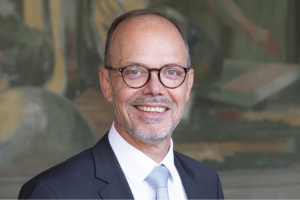
Antoine Geissbühler wears many hats—physician, academic, innovator, and institutional leader—and is at the forefront of digital transformation in healthcare. In this wide-ranging conversation, the Dean of the Faculty of Medicine at the University of Geneva and President of the BioAlps Association shares his journey, insights into Geneva’s unique life sciences ecosystem, and his vision for leveraging digital health to strengthen systems globally.
To begin, could you briefly introduce yourself to our international audience and walk us through the various roles you currently hold?
My name is Antoine Geissbühler. I am a physician by training, specialising in internal medicine here in Geneva. I later moved into the field of digital medicine, then known as medical informatics. The essence of the field remains the same: it is about managing information intelligently to improve healthcare delivery.
I spent five years at Vanderbilt University in the US, developing clinical information systems. Upon returning to Geneva University Hospitals, I was appointed Head of Medical Informatics and tasked with building and deploying the hospital’s clinical information system. At the same time, I became a professor at the Faculty of Medicine.
Over the years, my involvement in digital tools expanded from strengthening health systems within the hospital, to the regional level, and eventually internationally. I now lead the Division of e-Health and Telemedicine at Geneva University Hospitals. We have implemented telemedicine and distance education networks across twenty five countries, primarily in developing regions, demonstrating that digital tools can significantly impact healthcare systems even in the most remote areas.
I also became Vice-Rector of the University of Geneva, responsible for its digital transformation, and currently serve as Dean of the Faculty of Medicine. In parallel, I am Head of Education and Research at the University Hospitals and continue as Division Chief for e-Health and Telemedicine.
Academically, I lead a substantial research team focused on implementation and evaluation sciences of digital health interventions. We host large-scale events in Geneva, including one during the World Health Assembly in May. We are a WHO Collaborating Centre and also hold a UNESCO Chair for digital medical education.
As Dean, I am more involved in strategic oversight, managing a faculty with more than 300 professors and a broad range of activities. A few years ago, I was approached to join the BioAlps Association. My role there has been to integrate digital health into what was traditionally a biotech and medtech-focused landscape.
My current passion lies in building translational ecosystems which connect fundamental research to patients and turning innovation into viable companies and start-ups. That is the core of my work at Campus Biotech, at the University, and through BioAlps.
How do you leverage these multiple responsibilities to create impact and foster connectivity between institutions?
The beauty of this kind of role is precisely the ability to be a connector across many different worlds. These ecosystems are complex and fast-evolving. They come with various constraints and opportunities. My job is to stay in the middle of these conversations—to listen, dispatch, and process information so that people, ideas, and institutions become connected.
This creates the conditions for collaboration and innovation. People can develop new ideas together, build new solutions, and then move forward to achieve great things. That is my function as Dean, within the hospital, and also through my involvement with the BioAlps Association.
Of course, one cannot do everything perfectly. But you rely on a team of talented individuals to transform these interconnections into real value. It is a very stimulating role.
What makes Western Switzerland’s life sciences ecosystem unique, and how do you see its international positioning, especially as President of BioAlps?
We often refer to it as the “Swiss Health Valley.” While it is not literally a valley, geographically it follows the Rhône River from the glaciers, through Lake Geneva, and into France. This arc around the lake and throughout Western Switzerland is densely populated with life sciences organisations.
There are about 70 research and academic institutions, including universities and university hospitals. Beyond the public institutions, the area is home to various innovation parks and over a thousand life sciences companies ranging from start-ups to large biotech firms.
In terms of density, it is one of the most concentrated ecosystems worldwide. This creates a dynamic, albeit complex and sometimes noisy, environment.
BioAlps was founded 20 years ago by the cantons (our regional governments), particularly their economic development departments, in partnership with academic institutions. The goal was to coordinate and leverage this rich environment.
Our role is to bridge the academic and economic spheres by organising events, facilitating partnerships, providing services, scouting technologies, and monitoring markets. These activities are rooted in the ecosystem’s richness. We regularly host events where hundreds of companies and academics meet, share ideas, and initiate collaborations.
Switzerland is known for its top universities, and UNIGE is one of them. Since becoming Dean of the Faculty of Medicine in July 2023, what would you say makes the University of Geneva stand out?
The University of Geneva is one of the leading universities in continental Europe. We are typically ranked among the top 50 or 60 globally, with a recent position at 50 in the Shanghai rankings. It is a comprehensive university, unlike EPFL nearby, which is focused on engineering. We host faculties in humanities, medicine, law, science, theology, economics, management, and social sciences which make it a rich and multidisciplinary institution.
It is not the largest, but it is the second biggest in Switzerland after Zurich. It is also one of the oldest, with a history nearing 500 years. What truly distinguishes it, however, is its location. Being in Geneva means being part of the “International Geneva” ecosystem.
This includes close connections with international organisations, NGOs, and governance bodies, creating a uniquely global outlook. In the health and life sciences sector, our proximity and close integration with the University Hospital is particularly notable.
My dual role as Dean and as Director of Education and Research at the hospital board is unusual, but highly strategic. It reflects the necessity of linking knowledge creation and innovation directly to patient benefit. Our medical research centre, for example, is physically linked to the hospital by underground tunnels. That proximity is symbolic and practical, encouraging translational research at every level.
The university itself is embedded in the city. It lives and breathes with the people of Geneva. This is not a remote campus, but a vibrant hub of cultural, intellectual, and academic life.
How are you helping bridge the gap between academia and real-world application at the university?
You are probably familiar with Campus Biotech. It is a key initiative where the University of Geneva is one of the primary stakeholders, alongside EPFL and Geneva University Hospitals. For us, it serves as a strategic model for the direction we want to pursue.
Campus Biotech embodies the entire continuum: from patients and volunteers, through clinical and translational research, to fundamental science and neurotechnology development. It integrates public research with private research centres, incubators, and start up spaces—all linked to high-end technological platforms. In the field of neurosciences, this ecosystem is already operational.
On the opposite side of Lake Geneva which is only about 15 minutes away given the small size of the city, we are developing a similar ecosystem in areas such as oncology, infectious diseases, vaccinology, and non-communicable diseases. The vision is the same: we aim to connect our labs and fundamental research directly with clinicians, enabling them to work side-by-side, often quite literally, with researchers. This physical and intellectual proximity is crucial.
Additionally, we aim to host start-ups and spin-offs in the same physical space as academic researchers. These start-ups, often born in university labs, benefit from staying close to their roots, at least initially. Their presence also plays a vital role in inspiring students, doctoral candidates, and postdocs, demonstrating that career paths are not limited to academia. There are alternative routes in innovation, entrepreneurship, and industry. This model is central to our strategy at the Faculty of Medicine and is already well-implemented at Campus Biotech in neurosciences. We are now actively expanding it in the other domains I mentioned.
And how about collaboration with large industry players? What is your take on Switzerland’s engagement with big pharma and biotech?
Geneva University Hospitals, being the largest in Switzerland, have extensive interactions with the pharmaceutical, biotech, and medtech industries. These relationships support a wide range of clinical trials, validation studies, and research collaborations.
At the moment, we are investing in expanding our Clinical Research Centre. It is a joint initiative between the Faculty of Medicine and the hospital and aims to strengthen our leadership in clinical trials, both industry-sponsored and investigator-initiated. The infrastructure is already active, but there is significant room for growth.
Switzerland is known for its complexity with 26 health ministers. How are you addressing nationwide digital integration in that context?
Switzerland is highly fragmented, with 26 cantonal health authorities, which makes national-level coordination quite challenging. That said, over the past 8 to 10 years, we have made considerable progress in developing nationwide infrastructures to federate data across university hospitals and academic institutions.
This is particularly crucial in the era of precision medicine. For common conditions, a catchment area of half a million people might suffice. But for rare or highly specific conditions, you need a critical mass of data that only national integration can provide.
We have been instrumental in building platforms to make clinical and research data interoperable, adhering to the FAIR (Findable, Accessible, Interoperable, and Reusable) principles. This encompasses clinical records, genomic data, proteomics, and more. The aim is to enable research at the national level, drawing from university and increasingly non-university hospitals, as well as direct patient data.
This vision, which began about a decade ago, is now coming to life. We expect significant growth in the next five years, expanding its reach across the entire health and research system.
In the context of a growing global competition, how do you see Switzerland evolving in this changing landscape?
Switzerland recently experienced a difficult period due to our exclusion from the Horizon Europe programme, which deeply affected our research collaborations. We are now thankfully re-entering that framework, which is vital.
Excellence cannot thrive in isolation. Competing only within Switzerland is not enough. We need to be part of the broader, more demanding European environment. That is why our national infrastructures are designed to interface seamlessly with European networks. These partnerships are absolutely necessary.
However, this European connection remains fragile, and some of our national policymakers still underestimate its importance. That said, Switzerland continues to have a strong education system. We are good at producing and attracting top researchers not just in academia, but in tech and industry as well. Lacking natural resources, our greatest asset is human capital. We must nurture, attract, and retain talent, because innovation ultimately depends on people.
From your perspective, what is Switzerland’s position in producing healthcare and life sciences talent? Are global organisations increasingly looking here for expertise?
The fact that so many international headquarters are based in Switzerland is a testament to this. Companies come not only for the quality of life, but also because of the availability of a highly skilled workforce.
For large corporations, this ecosystem is quite favourable. Start-ups face more challenges. While we are improving, the environment is not yet as supportive as it could be for scaling up. Many Swiss start-ups still seek to grow abroad once they reach a certain stage, drawn by larger markets and easier access to capital.
That is something we are trying to change by improving access to venture capital and refining the regulatory and fiscal landscape. While I am not an expert in these areas, it is clear that we need better mechanisms to retain high-growth start-ups in Switzerland.
Nevertheless, we perform very well in innovation metrics, such as patents per capita. We excel at supporting early-stage ventures and creating spin-offs, but we must do more to help them grow into global players without leaving the country.
With your extensive experience in digital health, how do you see Switzerland’s position in the digital transformation of healthcare?
The digital ecosystem is growing rapidly here. Zurich, for example, is now home to one of Google’s largest research centres. These tech giants come because they know they will find and retain exceptional talent.
Now, our challenge is to ensure that this digital expertise is not only serving commercial tech purposes but also benefiting health and life sciences. This sector is both meaningful and economically promising. Health systems consume an increasing share of GDP, and they generate enormous amounts of data.
Healthcare is a domain where digital tools can truly make a difference, improving systems and the quality of care. That is why we are expanding our efforts in digital health through initiatives like BioAlps.
At least a third of our start-ups in the life sciences are now in the digital space—working on apps, sensors, data analytics, and related technologies. What makes Western Switzerland particularly promising is the ability to combine digital innovation with our other regional strengths, such as microtechnology.
Coming from a tradition of precision mechanics and watchmaking, we have developed expertise in microelectronics, microfluidics, and precision engineering. When combined with smart digital systems, this opens the door to next-generation devices like advanced insulin pumps or lab-on-a-chip diagnostics.
It is not about digital alone. It is about how digital intersects with biotech, medtech, and engineering to create truly integrated solutions.
And how are you integrating this digital shift into education and the curriculum at the Faculty of Medicine?
We already offer curricula specifically focused on biomedical sciences and digital health. What is even more important, though, is connecting with technical universities, whether EPFL or the applied sciences universities here in Geneva.
We work collaboratively in shared labs, bringing together diverse expertise. Innovation rarely comes from a single brilliant mind. It requires interdisciplinary teams made up of scientists, engineers, clinicians all working together.
We also benefit from mechanisms like Innosuisse, Switzerland’s innovation agency. It funds projects that bring academic research together with applied tech development and end-user integration. These vehicles are crucial for driving meaningful innovation.
To conclude, is there anything you would like to share with our international readers that we have not touched on yet?
Western Switzerland is not only a great place for innovation and translating research into real value, it is also a wonderful place to live and experience. We now have the right mind-set and conditions to connect the entire spectrum. From fundamental research to patient care, and from innovation to societal impact, through start-ups and partnerships with industry.