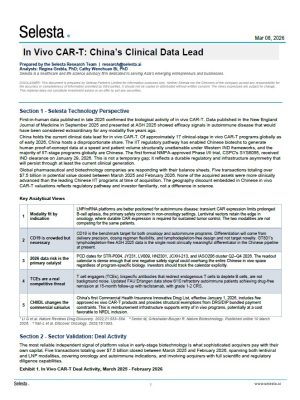
In Vivo CAR-T: China’s Clinical Data Lead
2026
The global landscape for genomic medicine reached an inflection point in late 2025. First-in-human data confirmed that in vivo CAR-T – once a theoretical ambition – is now a biological reality, capable of extraordinary efficacy in patients with hard-to-treat autoimmune diseases.
As this exclusive new Selesta* report shows, China has secured a commanding global lead in this space. Driven by a unique Investigator-Initiated Trial (IIT) regulatory framework that compresses standard clinical timelines by up to 18 months, the country now hosts a disproportionate share of the world’s approximately 17 clinical-stage programs as of early 2026.
This structural advantage has already attracted over USD 7.5 billion in global deal activity, with major Western pharmaceutical players like Eli Lilly, BMS, and AbbVie placing multi-billion-dollar bets on the durability of Chinese non-viral LNP and lentiviral platforms.
As the sector moves into a dense 2026 readout calendar, the focus shifts from proof-of-concept to commercial viability. In China, a new Commercial Health Insurance Innovative Drug List (CHIIDL) provides a dedicated reimbursement pathway and exempts these therapies from rigid bundled-payment constraints.
Meanwhile, manufacturing economics could dramatically reduce patient costs from over USD 350,000 to approximately USD 10,000. This would bring these innovative treatments within the realms of private insurance coverage and potentially even national public insurance (NRDL) negotiations, transforming in-Vivo CAR-T into a broadly accessible outpatient reality in China.
* Selesta, a PharmaBoardroom content partner, is a healthcare and life science advisory firm dedicated to serving Asia’s emerging entrepreneurs and businesses. Learn more at selesta.ai
The global landscape for genomic medicine reached an inflection point in late 2025. First-in-human data confirmed that in vivo CAR-T – once a theoretical ambition – is now a biological reality, capable of extraordinary efficacy in patients with hard-to-treat autoimmune diseases.
As this exclusive new Selesta* report shows, China has secured a commanding global lead in this space. Driven by a unique Investigator-Initiated Trial (IIT) regulatory framework that compresses standard clinical timelines by up to 18 months, the country now hosts a disproportionate share of the world’s approximately 17 clinical-stage programs as of early 2026.
This structural advantage has already attracted over USD 7.5 billion in global deal activity, with major Western pharmaceutical players like Eli Lilly, BMS, and AbbVie placing multi-billion-dollar bets on the durability of Chinese non-viral LNP and lentiviral platforms.
As the sector moves into a dense 2026 readout calendar, the focus shifts from proof-of-concept to commercial viability. In China, a new Commercial Health Insurance Innovative Drug List (CHIIDL) provides a dedicated reimbursement pathway and exempts these therapies from rigid bundled-payment constraints.
Meanwhile, manufacturing economics could dramatically reduce patient costs from over USD 350,000 to approximately USD 10,000. This would bring these innovative treatments within the realms of private insurance coverage and potentially even national public insurance (NRDL) negotiations, transforming in-Vivo CAR-T into a broadly accessible outpatient reality in China.
* Selesta, a PharmaBoardroom content partner, is a healthcare and life science advisory firm dedicated to serving Asia’s emerging entrepreneurs and businesses. Learn more at selesta.ai

Sharing Link
or sharing via


