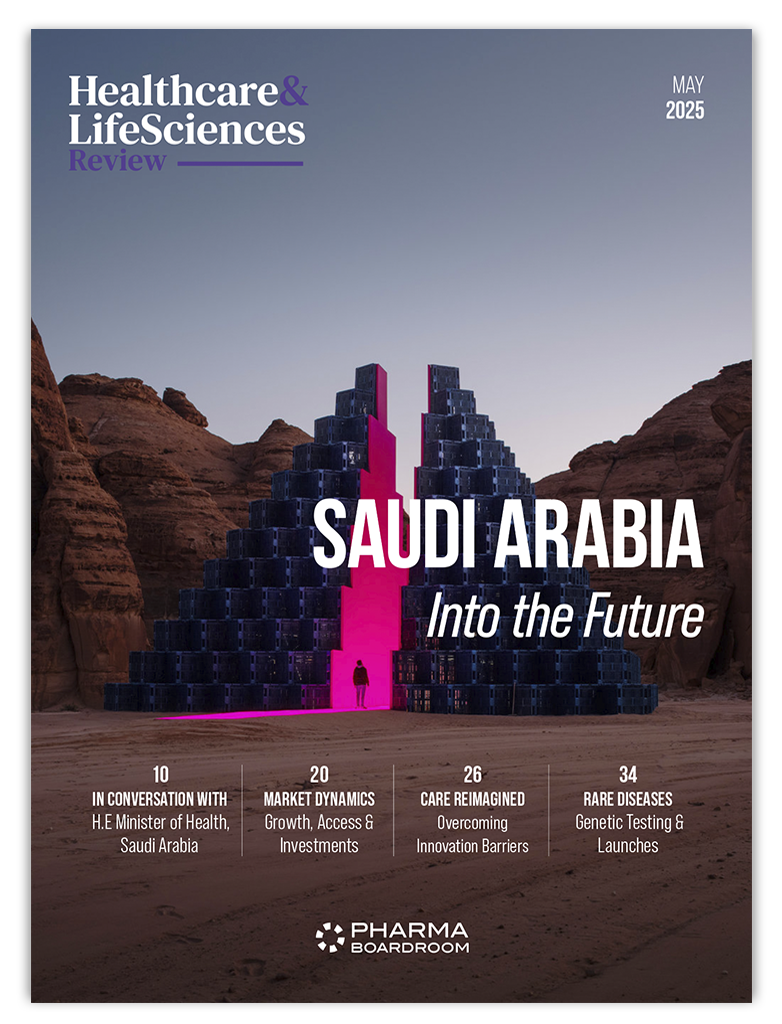

Saudi Arabia’s pharmaceuticals market grew an impressive 9.1 percent in 2024 underscoring its position as the regional heavyweight, and projecting a sales value of around USD 11.6 billion, which constitutes approximately 32 percent of the total share of the Middle East and Africa (MENA) region in the global marketplace. Yet with the Kingdom’s newfound regulatory maturity and the strides it has made towards creating a solid healthcare ecosystem, Saudi’s rising appeal for the international life science community goes beyond market volume and value.
“With a population of over 34 million propelling a steady rise in demand for healthcare solutions within the Kingdom and sales of patented drug consumption supported by both the nation’s affluence and the preference for originator and branded drugs among consumers and prescribers, doing business in Saudi makes great business sense for most multinational innovative drug developers,” reasons Hugo Hagen country division head for pharmaceuticals for the MENA at the iconic German biopharma outfit, Bayer.
“For Big Pharma, key factors such as market size, access to innovation, and the funding available for new treatments are crucial in assessing the attractiveness of a market, and Saudi Arabia scores highly on each count,” he observes.
Yet the Kingdom’s rising appeal in the eyes of the international life science community, transcends just market volume and value, with drugmakers also understanding the country’s role as the economic and developmental hub of the Middle East in driving transformation across the region. “The scale and ambition of Saudi Arabia’s initiatives in the healthcare and life science space present extraordinary prospects for businesses, beyond day-to-day growth,” opines Marwan Omar, general manager of the GCC Cluster at Swiss outfit Ferring.
‘For companies operating in the region, investing in Saudi Arabia is not merely an option—it is a strategic necessity. The Kingdom’s leadership and forward-thinking projects position it as a focal point for innovation and progress, making it an essential pillar for the success of organizations like Ferring aspiring to operate at the forefront of regional and global healthcare advancements,” he insists.
“Saudi Arabia’s emphasis on innovation and strategic regional position makes it increasingly influential within world healthcare supply chains. More and more, the country is engaging in global conversations and playing a proactive role shaping the future of medecine so can be considered a growing force and genuine power player in this part of the world ,” concedes Hagen.
Regulatory Plain Sailing
With patented drug spending accounting for 54.4 percent of the country’s drug market, Saudi Arabia holds the prospect of making hefty returns for innovative drugmakers. Moreover, the increasing efficiency of its regulator and enthusiasm for cutting edge, latest-generation therapies has tended to impress the boardrooms of Big Pharma.
“Over the past five or so years, Saudi Arabia has undergone a fundamental metamorphosis in the way it approaches healthcare regulation, shaped by a broader ambition to position itself as a regional life science hub,” affirms Abed Sabra, general manager at Roche.
“This shift has brought about a more progressive and collaborative regulatory environment – one that increasingly prioritizes innovation, access, and structured engagement with multinational pharmaceutical companies – along with clearer regulatory pathways, more consistent dialogue, and a genuine willingness to address access-related challenges in partnership with the industry,” he continues.
“My experience of working with the Saudi FDA has been exceptional. Their agility and patient-centric approach set them apart from many other regulators in the region. Not only have they streamlined regulatory processes through an abridged approval methodology, significantly reducing the time it takes for innovations to reach patients, but they have also introduced fast-track pathways for treatments that address critical unmet medical needs. enthuses Mohamed Fawzy, country president at Pfizer which has already had two products granted this designation. “One of the most impressive initiatives is the breakthrough designation pathway, which accelerates approvals for highly innovative treatments with high-impact potential,” he specifies.
“Looking ahead, I have full confidence that our first ADC therapies will follow the same fast-track pathway. The key question we are now discussing internally is whether we could launch a breakthrough therapy in Saudi Arabia before the US. We are open to this idea, but I would want to ensure that the treatment aligns with Saudi Arabia’s unique healthcare needs—for example, targeting sickle cell anaemia or specific types of cancer that are highly prevalent in the region,” elaborates Fawzy.
Saudi Arabia has taken extraordinary strides in creating a healthcare ecosystem designed to attract and accelerate innovation, agrees Lyes Salah, general manager at Amgen.
“The SFDA’s attainment of Maturity Level 4 certification from the World Health Organization (WHO) in 2023 marked a significant milestone, underscoring its commitment to global regulatory excellence and its ability to facilitate timely access to ground-breaking therapies. Our experience with the regulator has been exemplary, characterized by a strong and constructive partnership. This collaborative approach has enabled us to introduce a rare disease therapy where Saudi Arabia became the first country, after the United States, to register the product,” he recalls.
“There can be doubt that the Kingdom has now progressed toward becoming a wave-one market for pharmaceutical launches,” concurs Sameh ElFangary, country president for the GCC and Pakistan at AstraZeneca. “Parallel submissions with leading regulatory bodies like the FDA and EMA are increasingly common. Today, products can be registered within 12 months, instead of 18 months historically, a pace that positions Saudi Arabia ahead of countries like Japan in terms of market entry,” he details.
Moreover, “the SFDA has also made strides in revising pricing and reference structures to better align with the value of innovation so that once products are introduced, patients have access without the burden of out-of-pocket costs — a key differentiator that sets it apart from many countries in developing regions,” perceives ElFangary.
Meanwhile the Kingdom allows for differentiated pricing based on the medicine, supporting the affordability of new treatments while ensuring that they remain accessible to a broad range of patients. This favourable pricing structure not only benefits the local healthcare system but also encourages continued investment in research and development.
That’s not to suggest that there aren’t still some outstanding areas ripe for improvement. “While SFDA has made astonishing strides, there’s still some work to be done to replicate this speed within the formulary process across various healthcare accounts. This includes government entities like the Ministry of Defense, National Guard, and universities,” points out Abbvie’s general manager, Ashraf Daoud.
Fresh Forms of Engagement
Saudia Arabia’s newfound regulatory maturity has naturally inspired a change in the way that innovative drug developers are choosing to engage with the local market. “Frankly the regulatory reforms have strengthened trust with private industry and spurred companies like our to invest more proactively and meaningfully in the Kingdom. Today, Roche Saudi Arabia is recognized not only for the innovation it delivers, but for the way it proactively participates as a healthcare partner committed to impact, integrity, and the long-term advancement of the Kingdom’s healthcare ecosystem,” confides Abed Sabra.
Such commitment to impact extends beyond areas traditionally associated with pharmaceutical companies. “For example, we’ve started supporting initiatives aimed at improving the quality of medical journalism in the region, recognizing that accurate and accessible health information plays a critical role in raising awareness and improving outcomes,” he adds.
“The strong receptiveness to innovation evident within the Kingdom unlocks new possibilities and incentivizes originator biopharma to go beyond purely transactional relationships,” agrees Boehringer Ingelheim’s general manager for Saudi Arabia, the Gulf and East Africa, Abdallah Hamed. “My company is proud to be playing a proactive role in collaborating in the design of a brand-new forward-looking Saudi healthcare system and apparatus ready to serve future generations,” he says, detailing how the German company has joined forces with Ministry of Health to establish early diagnostics and promote awareness across the local medical and patient communities about the interconnectivity of cardiovascular, renal, and metabolic diseases.
Other actors have meanwhile been ramping up their in-country footprints and infrastructure so as to take full advantage of the new innovation-friendly and collaborative regulatory environment.
“Recordati moved swiftly to establish a dedicated local team in Saudi Arabia to deepen our engagement with regulators, healthcare professionals, and key stakeholders. A major milestone in this strategy was the launch of a Technical Scientific Office, allowing us to align closely and interface directly with government authorities, healthcare institutions, and scientific experts,” says Khaled Elrefae the Italian rare disease and metabolic disorder specialty player’s general manager for the MENA.
“Historically, we operated in the region through a distributor-led model, ensuring product availability through local partners. While this model used to be effective, the prevailing environment demands a decidedly more direct and proactive approach to stay relevant , especially with the rapid maturation of the regulatory landscape, the eagerness of public and government entities to collaborate with private industry, and the healthcare system now prioritizing state-of-the-art, sophisticated and specialized treatments,” he believes.
Generics Appeal
Generics drug makers also have plenty to be happy about. According to IQVIA, the local off-patent market is projected to grow from USD 3.37 billion in 2023 to USD 5.32 billion by 2031, registering a CAGR of almost 6 percent.
“Saudi Arabia ranks as one of the top five markets within our Europe and Middle East region. As the largest market in the Middle East, it naturally receives a high level of focus from our board of directors, with numerous product launches and strategic projects specifically tailored for the Kingdom,” reveals Daniel Vella Friggieri, regional CEO for Europe and the Middle East at South Africa’s Aspen Pharmacare, a leading developer of post-patent branded medicines. “In fact, one of our key brands in Saudi Arabia ranks among our top five brands across the entire region, despite only being available in the Kingdom which is emblematic of the strategic relevance of the market in our sector,” he acknowledges.
Such sentiment is mirrored by Amgad Talaat, Saudi regional cluster head and leader of global strategic alliances at Egypt’s EVA Pharma. “Having firmly established our dominance within our home market, we identified Saudi Arabia as a strategic focal point, for the next phase of our growth trajectory. The combination of regulatory clarity, governmental support, and a commitment to fostering investment made Saudi Arabia the standout candidate,” he explains. “Presently, we market 30 registered products in the Kingdom but are aiming to expand this in-country portfolio to 50 products before the end of the year.”
And, by way of demonstration the seriousness of the company’s commitment to the country, EVA Pharma will be investing over 450 million SAR (approximately US $150 million) to construct a cutting-edge manufacturing and research complex comprising five facilities in-kingdom.
Furthermore, there are additional incentives on offer for that segment of the market beyond base sales volumes intrinsic to their being a mid-size population. “What sets Saudi Arabia apart is that it has introduced targeted initiatives to attract investment and support branded generics, including localized pharmaceutical development,” explains Ayman Cheikh-Lahlou, chairman & CEO of Dubai-headquartered Cooper Pharma. “A standout example is the Value-Added Medicine (VAM) guideline, which allows companies to present new concepts and engage in structured discussions to define approval pathways—an approach rarely seen in our region,” he argues.
Profound Societal Change
Finally, deep societal changes are driving new growth spots and opening up hitherto unexploited areas of the marketplace. Women’s health is a case in point. “Historically overlooked in Saudi Arabia, women’s health has gained prominence through robust awareness campaigns, particularly those focusing on breast cancer, which have successfully mobilized a unified effort across sectors. These campaigns have created a unique momentum in Saudi Arabia, unmatched by other countries,” says Ferring’s Marwan Omar.
His company has taken a leadership role in addressing these gaps, offering a portfolio of products around fertility that span the continuum from conception to childbirth, while also addressing critical needs such as preterm labour and postpartum haemorrhage, areas where few competitors had hitherto ventured.
“These healthcare advancements align with the broader societal changes under Vision 2030, which emphasize women’s empowerment and inclusion in the workforce. The resulting cultural shift has fostered more open discussions about women’s health and broader societal issues, creating an environment where these topics are better understood and addressed,” explains Omar. “IVF cycles have increased to approximately 33,000 annually, with ovulation induction treatments—another critical fertility option—matching this figure. Together, these advances reflect underlying growth momentum in the segment,” he reasons.
“What is so special about Saudi Arabia is this is a market on the move, where immense progress is underway,” concludes Amgen’s Lyes Salah. “From the moment I arrived in the Kingdom, I was captivated by the nation’s unique and vibrant energy. There is a pervasive sense of optimism and determination here—a ‘can-do’ mindset that fosters an environment of innovation and progress in which everyone is vying to get a slice of th