We are living in uncertain times. The US government’s rapid-fire retreat from development aid and multilateral participation has shaken up the global system but – as Brendan Shaw argues, reflecting on the 2025 World Health Assembly – this has created a major opportunity to reshape the international order for the better. Whether some of the collaborative projects decided in Geneva – most notably a Global Pandemic Agreement – hold remains to be seen, but Shaw is hopeful that a more participatory intersectoral system could be on the cusp of emerging.
“In the midst of chaos, there is also opportunity”
Sun Tzu, The Art of War
“You never want a serious crisis to go to waste”
Rahm Emanuel, former Chief of Staff to President Barack Obama, 2008
“The agreement is a victory for public health, science and multilateral action”
Dr Tedros Adhanom Ghebreyesus, WHO Director-General, 2025
There was no shortage of sage quotations about disruption and chaos leading to opportunity at this year’s World Health Assembly (WHA) for the World Health Organization (WHO).
Against the backdrop of unprecedented disruption to the established world order, over the last few weeks Geneva has been full of conversations about the future of the global health agenda, United Nations agencies contemplating their future, and debates about the state of multilateralism in the face what’s euphemistically been called the ‘multipolar era’.
While there were many important issues on the agenda during this year’s WHA, such as a decision on rare diseases, debates on health financing, and the first ever side event on menopause, the Assembly was dominated by two major issues demonstrating that out of chaos and disruption can come new opportunities: the endorsement of the Global Pandemic Agreement, and the US Government’s funding cuts.
Global Pandemic Agreement endorsed
After three years of at times torturous negotiations, the WHO Pandemic Agreement was endorsed by acclamation at the WHA, triggering a standing ovation. In the end, 124 countries voted in favour, 0 against, while 11 countries abstained.
The legally binding WHO Pandemic Agreement will come into force once 60 countries have ratified it. It contains a variety of provisions to improve how countries prepare for and manage future pandemics, including provisions related to timely and equitable sharing of information, access, benefits, genetic sequences, medicines and vaccines during pandemics.
There is still a lot of work to do – the endorsement of the Agreement by the WHA could be thought of as the ‘end of the beginning’ in what will be a long road ahead.
One particularly contentious area that has yet to be resolved is the annexe on Pathogens and Benefits Sharing (PABS) under Article 12 of the Agreement. This includes, amongst other things, provisions for public financiers of R&D to require equitable benefits and access sharing from the commercialisation of that R&D. The Agreement also includes provisions around procurement of medical technologies like vaccines, medicines and diagnostic tools during a pandemic (Article 14), and mechanisms to allow health care companies to allocate 20 percent of their production of medical technologies available to WHO during a pandemic, with the latter distributing these according to public health need and equity for low-income countries (Article 12). The PABS provisions will be negotiated by an Intergovernmental Working Group that will have 12 months to come back to the 2026 WHA with a draft annexe.
As the WHO’s media release on the Agreement noted, there are implications for pharmaceutical companies:
“According to the Agreement, pharmaceutical manufacturers participating in the PABS system will play a key role in equitable and timely access to pandemic-related health products by making available to WHO ‘rapid access targeting 20 percent of their real time production of safe, quality and effective vaccines, therapeutics, and diagnostics for the pathogen causing the pandemic emergency.’ The distribution of these products to countries will be carried out on the basis of public health risk and need, with particular attention to the needs of developing countries.”
During the Agreement negotiations, these proposals became contentious as there were calls for pharmaceutical companies to fund the development of pathogen monitoring, for companies to foot the bill for pandemic action, and to give up the intellectual property of their medicines. The International Federation of Pharmaceutical Manufacturers and Associations (IFPMA) has said that future provisions should be voluntary, that intellectual property should be respected, and that the Agreement “is a starting point, not an end in itself.” All of this is proof that the negotiations of the PABS will not be easy going forward.
The Intergovernmental Working Group will also design mechanisms and global supply chain measures to support the equitable distribution of vaccines to poorer countries during a pandemic, something that didn’t happen effectively in the face of ‘vaccine nationalism’ during the COVID-19 pandemic.
In some ways, the Pandemic Agreement is an example of a new opportunity emerging from the chaos and disruption of the COVID-19 pandemic. The treaty is designed as a multilateral tool to avoid the problems that emerged in managing that pandemic, and to do things better in future pandemics. The challenge is whether the world can land on an Agreement that doesn’t kill the goose that lays the golden eggs, namely, medical innovation.
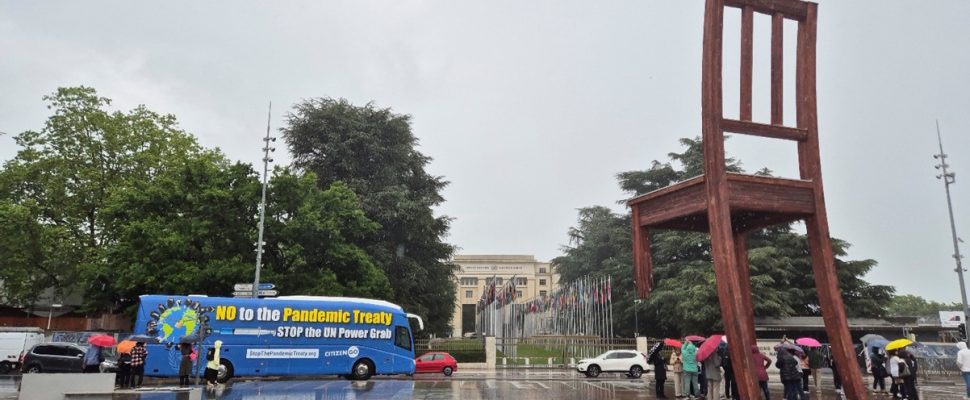
Of course, not everyone was happy with the Agreement. Some criticised it as being too weak because countries will not be penalised if they ignore the Agreement, while some governments said it risked undermining national sovereignty, in spite of the Agreement text including unique guarantees protecting national sovereignty. There were even paid buses driving outside the Palais des Nations, where the WHA was being held in Geneva during the negotiations, protesting the Agreement (see cover photo, above).
US government funding cuts
While one chaotic global issue was making progress, hanging over all the discussions in Geneva was the US Government’s decision to pull out of the WHO, cut funding for multilateral agencies and development aid, and criticise the multilateral agenda. For example, the WHO has had to reduce its staffing levels in the face of a 21 percent funding cut as a result of the US withdrawal.
Throughout WHA week, phrases like “constraints on financing” or “finance constraints” were everywhere. The significance of the financial challenges faced by the WHO and other UN agencies was demonstrated by the fact that this was the first time people could remember that ‘Budget’ was amongst the first items of business on the WHA agenda.
Make no mistake, the US Government’s decisions have caused consternation in UN circles, with Geneva full of stories of people suddenly losing their jobs, agency budgets being cut by 30 percent and 40 percent, and work programs being rolled back or cut short. The global health sector is reeling in shock.
Of course, the US isn’t the only country that has cut aid. The OECD estimates that international aid from official donors fell by more than seven percent in real terms last year – the first time in six years, and that such assistance fell in 22 countries. So, it’s a big problem.
Despite this, one theme that kept emerging was the notion that out of chaos and disruption comes opportunity. Somewhat surprisingly, the view of many in Geneva is that there’s no doubt the UN system and its agencies need a shake-up. Moreover, there was much positive talk by many in town of the need to find new ways of working with sectors and actors that wouldn’t have been possible before.
However, it’s the way the US Administration has suddenly announced its cuts that has left many people angry and determined to press ahead. With little to no warning, agencies, programs and people have been left effectively stranded.
There is plenty of discussion in global health circles about the opportunities for other governments, countries and foundations to pick up the slack where the United States has stepped back. For example, the Chinese Government has already indicated it may commit additional funding to fill the WHO’s financial shortfall left by the departure of the United States, and the WHO is attracting new first-time funders in its latest funding rounds.
There was also lots of talk in Geneva of the need for new partnerships, finding new funding sources, and for agencies to consider working with stakeholders that they traditionally could not have partnered with. Already, several UN agencies are opening discussions with other countries and stakeholders to help fill the vacuum left by US funding cuts.
There was also more talk about low- and middle-income countries doing more to fund their own health care systems, and more discussions about innovative finance models for healthcare like impact funds, new public-private partnerships, and getting the private finance sector involved.
As one speaker said in Geneva during the week: “It’s pretty clear we will never go back. It’s a paradigm shift.”
What does all this mean for the pharmaceutical industry?
In geopolitical and economic terms, the retreat of the US and others from the established multilateral health policy and architecture leaves a leadership and funding vacuum that others may fill.
An interesting question is whether pharmaceutical companies can and should work with others to step in and fill the breach. The debate about the appropriate role of pharmaceutical companies partnering, co-funding and investing in health initiatives is not a new one. For years, the industry has had a range of collaborative partnerships and funding models at both the company and industry levels.
For the pharmaceutical industry, the issue is made even more complicated by the retreat from ‘ESG’ terminology in business strategy, in part triggered by the Trump Administration’s pushback against such strategies. This has refuelled the broader debate about whether companies in all business sectors should just focus on making profits and leave the social stuff to someone else, or whether they should take a role in driving environmental, social and governance changes – the so-called ‘stakeholder’ vs ‘shareholder’ capitalism debate.
Even before the seismic shifts in global health finance we’ve witnessed in recent weeks, the question about how and why pharmaceutical companies could contribute to access to medicines and health care was yet to be fully answered.
The pharmaceutical industry, of course, has seen its own restructuring, job losses and sudden changes in direction in recent times. For corporates, it’s just part of the business.
However, out of the chaos come opportunities, and many people in UN circles are starting to look at re-examining ideas for partnerships that were previously thought impossible, or even heresy. The crisis in funding and leadership in global health is triggering real reflection on whether some of the historical barriers to collaboration need to be broken down.
Whether pharma companies want to be part of this conversation is another issue. Engagement doesn’t come without some risks, but the opportunities for companies, both from a philanthropic perspective and from a commercial business perspective, are worth exploring. The push for regional self-reliance in the context of pandemic preparedness, with efforts to diversify the production and supply of medicines, could present commercial opportunities for pharma companies, but also test ESG principles, which in turn are being questioned by some governments.
Ironically, it’s possible that the US government’s pullback from multilateral health initiatives could trigger the kind of cross-sectoral and cross-national collaboration envisaged in the UN Sustainable Development Goals for health, but was never quite achieved.
Now, that would be a crisis not wasted.
Watch this space.
Brendan Shaw is the Principal of Shawview Consulting and an Adjunct Professor at the Sydney Pharmacy School, Faculty of Medicine and Health, University of Sydney.