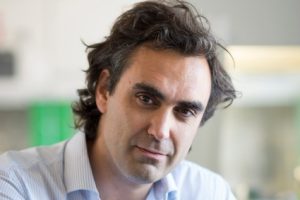
Prof. Andrea Alimonti, Director of the Institute of Oncology Research in Bellinzona, a leading Swiss centre focused on translational cancer research, shares his international journey from Rome to New York , Boston, and now Ticino, where he leads a growing, high-impact research institute. Under his leadership, IOR is expanding with a new facility to host cutting-edge labs and biotech start-ups, aiming to fast-track breakthroughs from lab to clinic. With core expertise in prostate cancer and lymphoma, the Institute leverages competitive grants, philanthropic support, and strategic partnerships to drive innovation. Alimonti also co-founded Ticino’s Faculty of Medicine, linking research and clinical training with ETH Zurich and other Swiss institutions.
Having been recently appointed Director of the Institute of Oncology Research, could you briefly walk us through your professional journey and how it has shaped your leadership today?
I am an oncologist by training, originally from Rome, where I completed my medical studies. At 25, I moved to the United States to pursue research, working at the Memorial Sloan Kettering Cancer Center and later at Harvard Medical School. My main research focus has been prostate cancer. While several therapies exist, most target the androgen receptor pathway, and resistance inevitably develops. That clinical challenge has driven much of my work.
In 2010, I returned to Europe and initially resumed clinical work in Italy, but I soon realised that research was where I belonged. I was fortunate to receive an ERC grant, which allowed me to establish my research group and relocate to Bellinzona. I was drawn to the Institute of Oncology Research (IOR) by its international reputation, shaped by our president, Franco Cavalli, who also founded European Society for Medical Oncology (ESMO) and built a strong oncology research culture here.
At that time, the Institute was much smaller, without the infrastructure we have today. Over the past decade, we have built a thriving scientific community focused on cancer immunotherapy and genomics, and now we are preparing to expand again with a second research facility. I was also involved in founding the Faculty of Medicine in Ticino, which offers a master’s-level programme in partnership with ETH Zurich and other Swiss universities. Students complete their bachelor’s at ETH or other Swiss Universities, then come to Ticino for their clinical training. I am currently a professor at ETH Zurich and Università della Svizzera italiana (USI), and previously held a professorship at the University of Padua, which I stepped down from last year to focus fully on IOR. It has been a rewarding journey, and taking on the directorship was a natural next step.
Where does the Institute stand today in terms of research, focus areas, and structure?
At IOR, we have chosen to focus deeply on two key areas over the years: prostate cancer and lymphoma. This focus has allowed us to build not just depth, but continuity across basic, translational, and clinical research. Despite being a relatively small institute by global standards with around 150 staff members, we are a significant size within Switzerland and have managed to punch above our weight in terms of scientific output and impact.
We have eight research groups primarily dedicated to prostate cancer and lymphoma, and recently expanded to include new groups in breast and melanoma. Our institute stands out due to its strong collaboration with the local hospital, the Oncology Institute of Southern Switzerland (IOSI), which has a solid clinical reputation in both prostate cancer and lymphoma. This collaboration facilitates the seamless transition of lab-based discoveries directly into early clinical trials. For example, my own group has published work in high-impact journals such as Nature and Cancer Cell, focusing on tumour immunosuppression, senescence-inducing therapies for prostate cancer, and innovative ways to reprogram myeloid cells to enhance immune responses to therapy. We are also exploring novel antibody-drug conjugates designed to transform immunologically “cold” tumours into “hot” ones, making them more receptive to immunotherapy. These concepts are not just theoretical, we are actively designing clinical trials based on them. One recent phase I/II study we led, targeting suppressive immune cells, yielded promising results, published in Nature.
Another key strength of the IOR is our collaborative ecosystem. Many clinicians from IOSI work alongside researchers in our labs, bridging science and patient care. In addition, our foundation supports this ecosystem by organizing global congresses. We host the International Conference on Malignant Lymphoma, the largest lymphoma congress in the world, attracting over 4,500 clinicians to Lugano every two years. We have also initiated the International Prostate Cancer Symposium that will take place next year, together with the Advanced Prostate Cancer Consensus Conference, further solidifying our leadership in these fields.
Additionally, we collaborate closely with industry, especially in preclinical prostate cancer studies, where we have robust in vitro and in vivo models. Our international lymphoma study group also provides access to rare lymphoma cohorts, attracting pharmaceutical partners eager to explore early-stage drug development. Altogether, IOR offers a rare combination of scientific excellence, translational power, and strong clinical integration, all from a small but highly connected part of Switzerland.
What is the vision behind the major expansion project currently happening at the institute?
We are expanding our campus with a new state-of-the-art facility that will house twelve advanced research laboratories. But it is much more than just adding space, it is a strategic investment in translational science. Our goal is to accelerate the journey from fundamental research to real-world clinical applications, particularly in oncology, where time can quite literally mean lives.
The new building will be located adjacent to our current site in Bellinzona, forming a unified research hub at the heart of the Bios+ innovation district. This area already brings together key players in biomedical science, including the Institute for Research in Biomedicine and the Insitute of Translational Research of EOC/USI. By physically and intellectually connecting these institutions, we are creating a neighbourhood of science that fosters collaboration across disciplines.
What is particularly exciting is the inclusion of private biotech start-ups close to these research facilities. This proximity between academic researchers and entrepreneurs is deliberate as it creates a dynamic ecosystem where scientific discovery and commercial innovation can feed off each other. We believe this model will not only enhance the pace of development but also improve the quality and relevance of the solutions we bring to patients. It is about building an environment where bold ideas can be tested, refined, and, ultimately, translated into better outcomes for people living with cancer.
How is the work at IOR financed, and what funding strategies are in place to support long-term growth and innovation?
The backbone of our funding comes from competitive grants and accounts for roughly 53 percent of our total support. These include awards from the Swiss National Science Foundation, the European Research Council, the Swiss Cancer League, and major EU programmes like Horizon Europe. These are highly competitive and peer-reviewed, so winning them is not only crucial to our work but also a strong validation of our scientific quality.
In addition, we receive support from private philanthropic sources. We also benefit from public support. Both the Canton of Ticino and the City of Bellinzona contribute annually, particularly toward maintaining and expanding our infrastructure and strategic development. Finally, we engage in collaborative projects with biotech companies, universities and hospitals, which bring in both funding and critical intellectual exchange.
You mentioned earlier the Faculty of Medicine in Ticino. Can you explain how that links to your work?
That has been one of the most rewarding projects I have been involved in. A few years ago, I helped co-found the Faculty of Biomedical Sciences here in Ticino. It is the first medical faculty of its kind in this region and was established in close partnership with ETH Zurich, the University of Basel, the University of Zurich and, of course, USI. The structure is innovative: students complete their bachelor’s training at institutions like ETH Zurich, and then come to Ticino for their master’s-level medical training, spending time in the local hospitals and research labs.
This dual academic-clinical environment gives them direct exposure to both patient care and scientific research. As part of this initiative, I hold a professorship at ETH Zurich, and this connection allows us to align our research mission with the next generation of physician-scientists. It is a wonderful example of Swiss collaboration—small in geography, but big in vision.
If you had to leave our audience with one message, what would it be?
I would say, come to Ticino. Come to IOR. Whether you are an academic researcher, a young investigator, or a biotech company, we have the expertise, the infrastructure, and the collaborative ecosystem to help you take your research further and faster. We believe in innovation that reaches patients. This is a place where scientific excellence is paired with clinical ambition, where discoveries don’t get lost in translation. And we are just getting started.